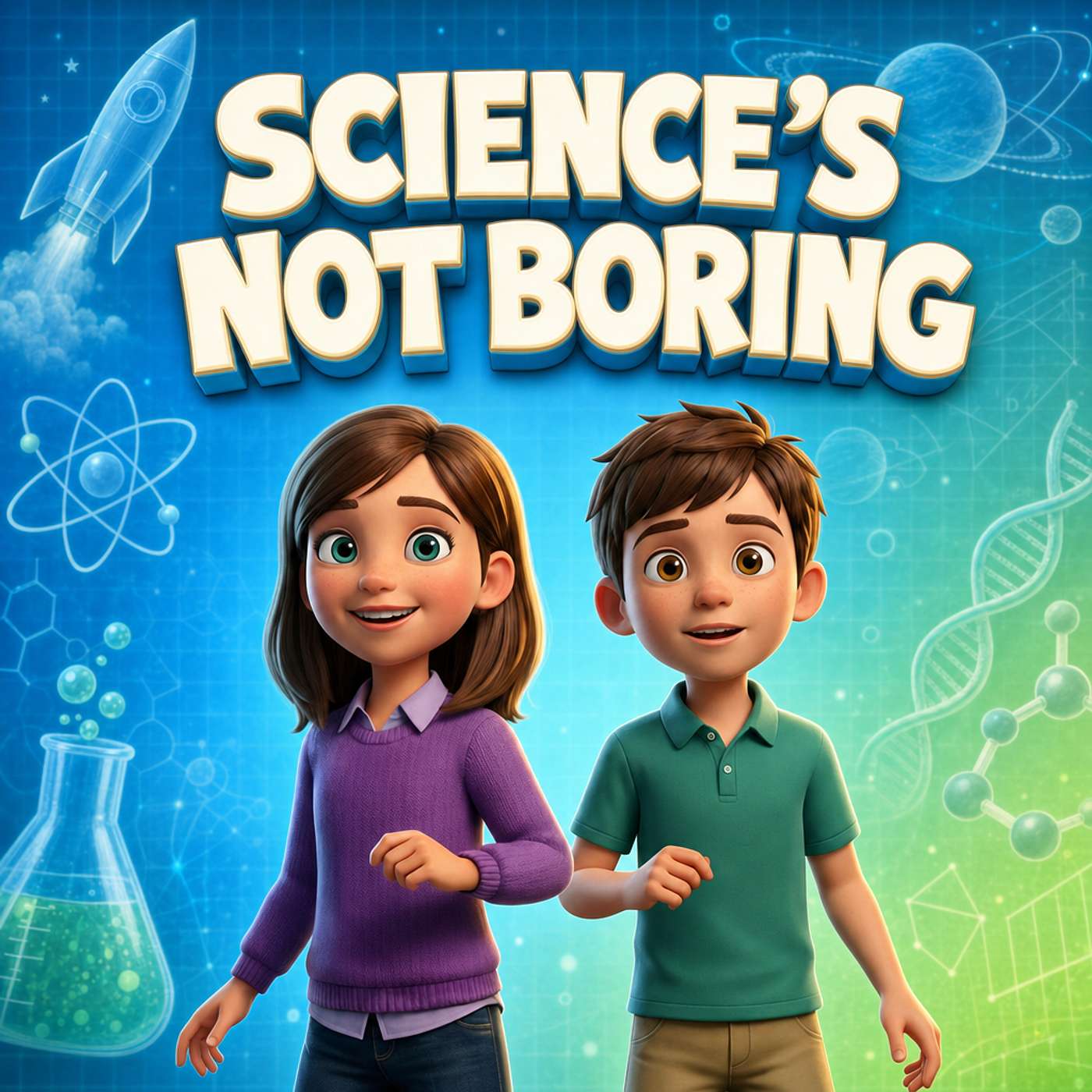
Science for Kids / Science's Not Boring: The Kids Science Podcast
Andere apps
Pocket Casts Overcast Castro Castbox Podcast Addict AntennaPod RSS-feed
A groundbreaking podcast for curious kids aged 4-12 that proves science is anything but dull.
Join our fictional AI hosts Mira, a brilliant 9-year-old, and her younger brother Finn, age 7, as they explore the incredible world of science. From exploding volcanoes and black holes to deadly venom and the tiny machines inside your own body, each episode uncovers the most astonishing, surprising, and sometimes mind-bending wonders of science - explained in a way that actually makes sense to kids.
Whether you're discovering how rockets blast into space, why dinosaurs ruled the Earth, what really happens inside a thunderstorm, how your brain pulls off impossible tricks, or why the ocean's deepest creatures glow in the dark - Science Is Not Boring transforms big scientific ideas into unforgettable stories that ignite curiosity and wonder.
Because science isn't a pile of facts to memorize. It's the story of how everything works - and how we figure it out.
A note on why we use AI. For us, AI allows us to deliver learning at a scale and quality that previously would have been too expensive. If we make the odd technical error, or the sound goes a bit funny, bear with us, we're trying our best. We hope you enjoy the show!
Afleveringen
-
What is an earthworm?
27 oktober 2026 · 13 min
Did you know there is a squishy creature living right under your feet that has ten tiny hearts, zero bones, and absolutely no eyes? Welcome to the wild, wiggly world of the amazing earthworm! Join Mira and Finn on Science is Not Boring as they dig deep into the dirt to uncover the unbelievable secrets of nature's ultimate gardeners. Lees meer
Discover how these unstoppable eating machines use invisible microscopic bristles to crawl through underground tunnels, and how they actually breathe oxygen directly through their moist skin! We will find out why world-famous scientist Charles Darwin spent forty whole years studying worm poop, and how he proved these little wigglers created the rich topsoil that feeds our entire planet. Plus, get ready to meet the terrifyingly awesome Giant Gippsland earthworm from Australia—a massive, slurping, gurgling monster worm that grows up to ten feet long!
Packed with mind-blowing facts, silly science experiments involving loud musical instruments, and a fun trivia quiz, this episode will completely change the way you look at the dirt in your backyard. Tune in and get ready to be amazed!
-
What is a big cat?
26 oktober 2026 · 10 min
Did you know that not every large feline is actually a "big cat"? Get ready to roar into the wild world of zoology to discover what makes a big cat a true big cat! Join Mira and Finn as we track down the magnificent members of the Panthera genus: lions, tigers, jaguars, and leopards. You will learn the amazing secret behind a lion's terrifying, 114-decibel roar—it is all thanks to a special, stretchy throat bone! But there is a catch: because they are built to roar so loudly, they cannot purr like your cute pet kitty! Lees meer
We also uncover the magic behind black panthers, find out why super-fast 70-mph cheetahs are not actually true big cats, and meet the biggest feline on Earth—the 660-pound tiger! Did you know a tiger's unique stripes are actually on its skin? Plus, discover how a special mirror-like layer in their eyes gives these top predators night vision that is six times sharper than a human's! Grab your binoculars and tune in to this purr-fectly wild episode packed with roaring facts, jungle secrets, and unbelievable animal superpowers!
-
What is uranium?
25 oktober 2026 · 14 min
Have you ever wondered what the heaviest natural element on Earth is? Get ready to dive inside the incredible, invisible world of atoms in this mind-blowing episode all about uranium! Join Mira and Finn as they uncover how a tiny piece of uranium the size of your pinky finger contains as much energy as an entire ton of coal! Discover the wild history of this super-dense metal, starting with miners who found mysterious "bad luck rock" in the mountains, to a German chemist discovering uranium in 1789. Then, bundle up for a trip to a snowy Swedish forest where brilliant scientists Lise Meitner and Otto Frisch did the totally impossible—they split the atom! You'll learn exactly how nuclear fission works, why radioactive energy is powerful enough to send the Voyager space probe billions of miles across the solar system, and how uranium was actually once used to make glass cups that glow neon green! It's a high-energy scientific adventure that will absolutely blow your mind. Put on your safety goggles and press play to learn why this tiny atom changed human history forever! Lees meer
-
How do tadpoles turn into frogs?
24 oktober 2026 · 13 min
Did you know a single mother frog can lay up to 20,000 squishy eggs at once? That's enough to fill a massive sports arena! Join Mira and Finn on an incredible underwater adventure to discover one of nature's most extreme shape-shifting magic tricks: how a tadpole transforms into a frog! Lees meer
When baby tadpoles hatch, they don't look like frogs at all. They are little legless swimming beans that breathe through gills, just like fish! But soon, a special chemical alarm clock goes off inside their bodies, telling them it is time to build a land-hopping amphibian. Discover the wild science behind metamorphosis, where back legs sprout, front legs pop out from under the skin, and lungs magically expand to breathe air! The wildest part? Tadpoles actually recycle and absorb their own tails for energy while their intestines shrink to get ready for a meat-eating bug diet!
Get ready to learn mind-blowing facts about frogs that survive being frozen into solid ice cubes, and super-jumpers that can leap over forty times their own body length! Hit play and uncover the awesome secrets of these tiny green superheroes!
-
What is a marsupial?
23 oktober 2026 · 10 min
Have you ever wondered what makes animals in Australia so weird and wonderful? Get ready to explore the incredible world of marsupials! Over 50 million years ago, the continent of Australia broke off like a giant puzzle piece and drifted away into the ocean. Because these animals were trapped on a massive lifeboat, they evolved into over 250 amazing species! Join Mira and Finn as they uncover the wild secrets of the pouch. Did you know a newborn kangaroo joey is completely blind, hairless, and exactly the size of a tiny pink jellybean?! You will be amazed to learn how this tiny baby climbs a giant mountain of fur all by itself to find its mother's pouch. We also dig into why wombats have backward-facing pockets (hint: it keeps the dirt out while they burrow!) and meet the fierce Tasmanian devil. This 8-kilogram creature packs a bone-crushing bite force of 553 Newtons, acting like nature's very own vacuum cleaner! Tune in for mind-blowing facts, a fun trivia quiz, and find out why marsupials totally rule the land down under! Lees meer
-
What was the first photograph?
22 oktober 2026 · 13 min
Have you ever tried sitting completely still without blinking, itching, or sneezing for eight whole hours? That’s exactly what you had to do to be in the very first photograph! Join Mira and Finn on a time-traveling adventure to discover how cameras actually work! First, we’ll travel back a thousand years to ancient Egypt with a brilliant scientist named Ibn al-Haytham. He discovered the magical "camera obscura"—a completely dark room that projected moving pictures of the outside world completely upside down on the wall! Then, we'll visit French inventors Nicéphore Niépce and Louis Daguerre, who finally figured out how to trap light on sticky metal plates to create permanent pictures. You won't believe how a man getting his shoes shined accidentally became the first human ever photographed! Finally, we'll zoom into the modern world to learn how heavy, bowling-ball-sized digital cameras turned into the super-fast phone cameras we use today. Discover the amazing science of bouncing light, millions of microscopic digital pixels, and the incredible history of photography. Get ready to smile and say cheese! Lees meer
-
What is the colossal squid?
21 oktober 2026 · 12 min
Are you ready to dive into the darkest, most freezing parts of the ocean? Join Mira and Finn on Science's Not Boring as they search for a real-life deep-sea monster: the colossal squid! Imagine a giant creature as long as a school bus and as heavy as a grizzly bear, swimming thousands of feet below the icy waves of Antarctica. This massive sea creature is the heaviest invertebrate on Earth! Did you know it has eyes the size of soccer balls? These gigantic, glowing eyes help it spot its biggest predator, the mighty sperm whale, in the pitch-black water. But this squid isn't defenseless! It has tentacles covered in razor-sharp, swiveling hooks that act like little tiger claws to trap its prey. Learn the incredible, and totally gross, true story of how scientists first discovered this alien-like animal inside a whale's stomach way back in 1925! Plus, find out how fishermen in New Zealand finally caught a complete, bright red colossal squid eighty years later! Get ready for an epic underwater adventure packed with fascinating facts and a super fun trivia quiz at the end! Lees meer
-
What is the rock cycle?
20 oktober 2026 · 13 min
Did you know that the ground beneath your feet is actually a giant, endless recycling machine? Join Mira and Finn on an epic geological adventure to discover the secrets of the rock cycle! You might think rocks just sit there being boring and gray for millions of years, but our planet is constantly melting, squashing, and baking them into completely new shapes! Learn about igneous rocks born from glowing red-hot lava that can reach over 2,200 degrees Fahrenheit, and discover how nature perfectly cracked 40,000 hexagonal pillars at the Giant's Causeway in Ireland. We will explore sedimentary rocks made from mud, sand, and trillions of ancient, squashed sea shells stacked together like a giant colorful layer cake! Plus, find out what happens when you bake limestone deep underground until it magically turns into beautiful, sparkling marble. Did you know the Earth even gets special rock deliveries from outer space every single day? Grab your hard hat and magnifying glass, because this episode proves that geology is definitely not boring! Tune in to find out how any rock can transform into another! Lees meer
-
How was Earth formed?
19 oktober 2026 · 12 min
Have you ever wondered where our home planet came from? Buckle up, space explorers, because we are traveling back four and a half billion years to witness the fiery, explosive birth of planet Earth! Before there were oceans, mountains, or even dinosaurs, Earth started as a giant, freezing cold cloud of space dust. But when an exploding star sent a shockwave through space, things got crazy! Tiny specks of dust crashed together like the ultimate bumper-car ride to form massive space rocks in a mind-blowing process called accretion. Soon, early Earth became a glowing, red, liquid lava planet floating in space! But the craziest part hasn't even happened yet. Imagine a Mars-sized planet named Theia slamming straight into Earth at twenty-two thousand miles per hour! This unbelievable cosmic collision blasted fiery debris into space, which quickly clumped together to create our very own Moon! Discover how a bubbling magma ocean finally cooled down, how steam created our first oceans, and where scientists found the oldest crystals on Earth. Join Mira and Finn on this spectacular adventure into the history of our solar system! Lees meer
-
How did the first plant grow?
18 oktober 2026 · 12 min
Have you ever imagined what Earth looked like 500 million years ago? Picture this: absolutely zero green! No trees, no grass, no flowers—just endless, bare, jagged rock. If you wanted to find a plant, you had to dive underwater to find floating green algae! But how did those plants finally crawl onto the dry, scary land? Lees meer
Join Mira and Finn on a prehistoric adventure to discover the greatest survival story in Earth's history! You'll learn how brave little green blobs survived scorching sunburns to become the very first land plants. Find out why they had no roots, leaves, or seeds, and how they stuck to rocks using tiny velcro-like hairs! Plus, meet Cooksonia, the two-inch-tall skyscraper plant that grew microscopic plumbing tubes to stand up straight. You won't believe how these tiny heroes literally created the first dirt, paved the way for all land animals, and even caused a global ice age! Get ready to explore the wild and wonderful world of pioneer plants. It’s an episode packed with giant surprises from the tiniest ancient heroes!
Vergelijkbare podcasts
-
 Omdat ik het zeg!
NPO Luister / EO
Laatste aflevering 4 november 2026
-
 Echte Oogappels
NPO Luister / BNNVARA
Laatste aflevering 10 december 2025
-
 Het Klokhuis
NPO Zapp / NTR
Laatste aflevering 9 oktober 2026
-
 Ik tel tot drie
Dag en Nacht
Laatste aflevering 4 november 2026
-
 Sara's Mysteries
NPO Zapp / NTR
Laatste aflevering 3 juli 2026
-
 Kleuter Podcast
Mirthe en haar Papa
Laatste aflevering 29 oktober 2026
- Categorieën
- Onderwijs , Kinderen , Gezin
- Verschijnt
- Elke dag
- Lengte
- Meestal 12 min
- Afleveringen
- 134
- Eerste aflevering
- 15 juni 2026
- Taal
- Engels