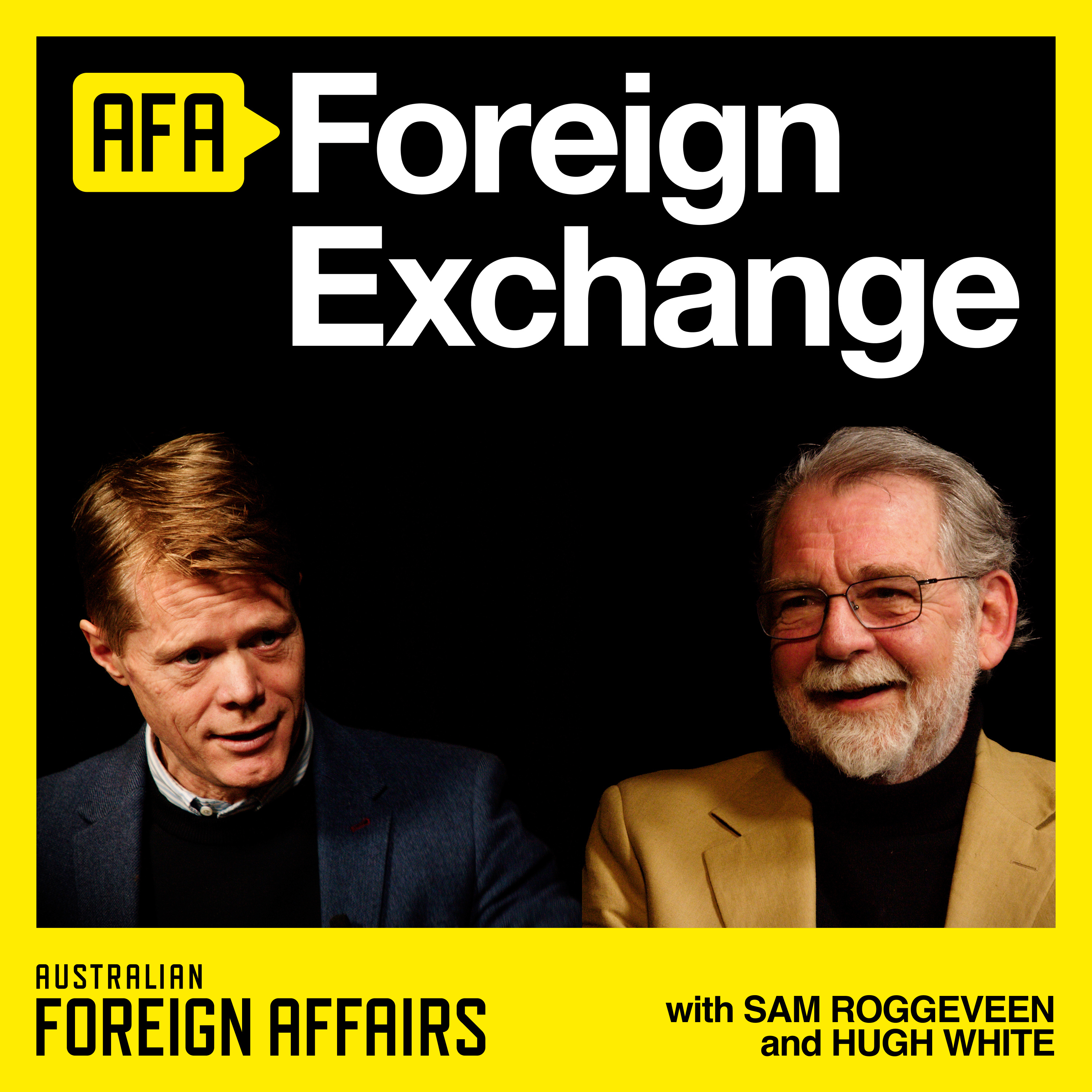
Foreign Exchange
Spotify Apple Podcasts Website
Andere apps
Pocket Casts Overcast Castro Castbox Podcast Addict AntennaPod RSS-feed
Every fortnight, Sam Roggeveen and Hugh White discuss major developments in international affairs affecting Australia and the region, from an Australian perspective.
Afleveringen
-
MIDDLING POWER: Can we handle being alone in the Pacific?
23 oktober 2026 · 44 min
Every fortnight, Sam Roggeveen and Hugh White discuss major developments in international affairs affecting Australia and the region, from an Australian perspective. Lees meer
“I never took never took the Chinese military bases in the South Pacific very seriously as a a military factor, leaving aside the broader political questions, because it's always seemed to me that compared to where we were, for example, when we were worried about Japanese bases in the South Pacific in the decades before the Second World War.”
“You know, if Australia plays its cards right, if we build the right sort of armed forces we need, it shouldn't be very difficult for us to be able to neutralize a Chinese base operating within the inner arc of islands for conflict.”
“But that doesn't mean they're not useful in a peace time setting, as a kind of a global network or at least a regional network.”
“There is a tendency here that I think, you and I, as former intelligence analysts would both be familiar with the problem of mirror imaging. The idea that just because we want something, the other side must want it as well.”
-
PLAN B: Counterinsurgency expert David Kilcullen on how to defend Australia without submarines
9 oktober 2026 · 32 min
This week, counterinsurgency expert David Kilcullen joins Hugh White to discuss his article in Australian Foreign Affairs, Plan B: How to defend Australia without submarines, by David Kilcullen Lees meer
“There's two ways it could fail.
“One could be that the US Virginia class submarines, which we were supposed to start seeing arrive from 2032, are simply not transferred across by the US government. And there's language in the agreement that allows the president to—sorry—requires the president to certify that the submarines can be transferred without any loss of capability to the United States, and Congress then has to sign off on that”
“And earlier in the year, Elbridge Colby expressed concern that US ship builders are not building US submarines fast enough. So, I think that is a flag that even the United States is thinking ‘okay, what if things do not transpire in such a way that we can actually transfer the submarines across.”
Compelling conversation, engaging debate and insightful perspectives. This series provides expert insights into Australia’s future in a changing world.
Foreign Exchange. Brought to you by Australian Foreign Affairs.
-
MINI-EPISODE: Should Australia go to war with China over Taiwan?
25 september 2026 · 23 min
Every fortnight, Sam Roggeveen and Hugh White discuss major developments in international affairs affecting Australia and the region, from an Australian perspective. Lees meer
“This is an extraordinarily serious choice.
“Now, we might feel uncomfortable about the idea of the Chinese getting control of TSMC (Taiwan Semiconductor Manufacturing Company Limited), for example, the chip fabs.
“But boy, you wouldn't pay that price to prevent that.
“If you're really worried about that, by the way, what you do is you bomb the fabs yourself, to deny them.”
Compelling conversation, engaging debate and insightful perspectives. This series provides expert insights into Australia’s future in a changing world.
Foreign Exchange. Brought to you by Australian Foreign Affairs.
-
‘Hoovering up’: How Australian spies operate
11 september 2026 · 23 min
Every fortnight, Sam Roggeveen and Hugh White discuss major developments in international affairs affecting Australia and the region, from an Australian perspective. Lees meer
“All of those styles of intelligence except the last one —HUMINT— is, of course, undergoing fantastically rapid change in the last few decades and that doesn't look like ending. I mean, SIGINT, when I first got into the business SIGINT was still largely a matter of, well, intercepting high frequency transmissions — if you go back to the sort of World War One, World War Two era. And, you know, then getting into satellites and so on.”
“But these days, intercepting other people's or intruding into other people's computer systems has become a vast part of the process. And so, the whole shape of what we used to call SIGINIT hardly seems an adequate word anymore”
“Signals is a very World War two word.”
“You know, it used to be the case that when you're trying to intercept other people's signals, you either had to get alongside a cable like the British splicing into the transatlantic cable at the beginning of World War One, sp they could they could intercept what the what the Germans were doing, or listening to high frequency radio, which is a very geographically based business where you could set up your antenna to listen became really critical.
“These days, that being what it is, the geography has almost become irrelevant.”
-
MIDDLE EAST: The US is losing, so why isn’t Iran winning?
28 augustus 2026 · 39 min
Subscribe to Australian Foreign Affairs: https://www.australianforeignaffairs.com/subscribe Lees meer
Every fortnight, Sam Roggeveen and Hugh White discuss major developments in international affairs affecting Australia and the region, from an Australian perspective.
“Can I just finish this sector on one observation, which might seem a little bit impertinent, and that is I don't think, in the grand sweep of history, what happens in the Middle East matters very much.
“The future of the global order, the future of America's role in the global order, will be decided in Europe and Asia, where it always is decided, because that's where the big power is.
“A great secret about the Middle East is that in the end, it's always kind of marginal. During the Cold War, it wasn't one of the central fronts. It wasn't until 1980 that the Carter Doctrine declared that the Americans would keep them out.
“During the post-Cold War era, the fact that the Middle East was the only part of the world that didn't seriously sign of, least for for a while, seriously sign on to the idea of American primacy didn't get in the way of the fact that American primacy became, for a while, the sort of, focus of of global order.”
Compelling conversation, engaging debate and insightful perspectives. This series provides expert insights into Australia’s future in a changing world.
Foreign Exchange. Brought to you by Australian Foreign Affairs.
-
BAMBOO DIPLOMACY: Vietnam and the art of not picking sides
14 augustus 2026 · 38 min
Every fortnight, Sam Roggeveen and Hugh White discuss major developments in international affairs affecting Australia and the region, from an Australian perspective. Lees meer
“But there's another layer on top of this which is the Treaty of Rarotonga—the South Pacific Free Zone Treaty. And that treaty, to which Australia is a signatory, says that nuclear weapons shall not be stationed on the territory of any signatory of that treaty. And so, we get around that by talking about a rotational arrangement.
“And as Mike Pezzullo, former colleague of yours, Deputy Secretary in the Defence Department, has helpfully pointed out in The Australian in recent weeks, come 2032 or thereabouts, the United States is going to be once again putting nuclear weapons on board its fast attack submarines.
“And some of those fast attack submarines are going to be stationed, or I should say rotating, through Submarine Rotational Force West at HMAS Stirling.
“So that raises a thorny problem for Australia: if those nuclear armed vessels are going to be rotated through HMAS Stirling. Does that put us in breach of the treaty?"
Compelling conversation, engaging debate and insightful perspectives. This series provides expert insights into Australia’s future in a changing world.
Foreign Exchange. Brought to you by Australian Foreign Affairs.
-
‘Why would China even bother to attack if you don’t taunt her’: Sam & Hugh answer your comments
31 juli 2026 · 52 min
Subscribe to Australian Foreign Affairs: https://www.australianforeignaffairs.com/subscribe Lees meer
Every fortnight, Sam Roggeveen and Hugh White discuss major developments in international affairs affecting Australia and the region, from an Australian perspective.
“And great powers do use armed force against countries that obstruct their vision of regional, or for that matter, global order. And, you know, it's worth remembering that that's why the United States has a great power went to war with Vietnam and Iraq and Iraq again, and Iran and Afghanistan.
“So, you know, Australia, thinking about its strategic future in Asia, can't afford to overlook the possibility that if Australia does effectively and sort of systematically oppose China's vision of regional order, then we can expect to get some pushback, and we can’t rule out the possibility that pushback includes military pushback.”
Compelling conversation, engaging debate and insightful perspectives. This series provides expert insights into Australia’s future in a changing world.
Foreign Exchange. Brought to you by Australian Foreign Affairs.
-
AUSTRALIA: China’s ballistic missile test has strikingly little to do with us
17 juli 2026 · 44 min
Every fortnight, Sam Roggeveen and Hugh White discuss major developments in international affairs affecting Australia and the region, from an Australian perspective. Lees meer
“I don't think we should also underestimate our capacity to overplay our hands here.
“There is a bit of a bullying tone to some of this stuff. I mean —leaving aside the fact that article two of the Ocean of Peace treaty declares our shared values, including the party's commitment to free and democratic institutions — that’s a bit rich when you’re signing the treaty with Sitiveni Rabuka— you know, leader of two coups.
“But also there's language about about not permitting, and this is not just in the in the Fiji agreement, but in all of the agreements in different ways, language about not allowing other countries to establish bases and so on.
“You know, and it's a bit asymmetrical. In the Vanuatu treaty, for example, it says is not allowed to have foreign bases, but we are.
“The sort of cuteness of some of this. I think we need to be very careful that we don't overplay our hand.”
-
The leapfrog to lithium-ion submarines: "If anyone can do this, it’s the Chinese"
19 juni 2026 · 40 min
Every fortnight, Sam Roggeveen and Hugh White discuss major developments in international affairs affecting Australia and the region, from an Australian perspective. Lees meer
“You have to be very clear where the capability trends are going.
“Intentions can change quickly, but it's worth making the point that the broader geostrategic framework within which intentions evolve can change more slowly.
“When we made the foundation of Australian defense policy throughout the 70s, 80s and 90s, even into the 2000, it was that: we didn't have to care much about China's military capabilities because we could not conceive that it would have an intention to use force against us. “Now, what's the big thing that's changed on the intention side is that in the decades ahead, we're expecting China to be much less constrained by American power and therefore to have opportunities, if it chooses, to use force against Australia free of interference from the United States. Which it wouldn't have had, which we didn't conceive it having decades ago.”
“There’s an element of intention that changes slowly, too.
-
The many ways in which Secretary of War Pete Hegseth is not Teddy Roosevelt
5 juni 2026 · 37 min
Every fortnight, Sam Roggeveen and Hugh White discuss major developments in international affairs affecting Australia and the region, from an Australian perspective.“The life type extension of the Collins—keeping as many Collins as possible in service and operationally viable for as long as possible—is really critical to the whole AUKUS[...]for two reasons.”“The first is because we won't have a submarine capability otherwise“But the second is we won't have enough submarines at sea to provide the training opportunities for enough submariners to ensure that we actually have the personnel required to sustain a viable submarine capability when the US boats arrive.“And I've long been of the view that the first hurdle at which we're likely to fall in getting to where the AUKUS plan was meant to take us was that we wouldn't succeed in upgrading, prolonging the life of the Collins sufficiently to keep enough submarines in water, to keep enough trainees going to sea, to give ourselves the personnel required to operate the AUKUS boats when they arrive. And that’s become more likely” Lees meer
Vergelijkbare podcasts
-
 Ondertussen aan de Hofvijver
NPO Luister / AVROTROS
Laatste aflevering 18 augustus 2025
-
 Audio Arguendo
Laatste aflevering 2 november 2026
-
 Ahead of the Threat: The FBI Cyber Podcast
Official FBI
Laatste aflevering 29 oktober 2026
-
 Playbook Canada
Politico
Laatste aflevering 31 oktober 2026
-
 Trust and Trade
American Bar Association, Antitrust Law Section
Laatste aflevering 2 november 2026
-
 RNIB Conversations
RNIB Connect Radio
Laatste aflevering 4 november 2026
- Categorieën
- Overheid
- Populariteit
- #1.666 van 40.237 podcasts in Nederland
- Status
- Loopt nog
- Verschijnt
- Om de week
- Lengte
- Meestal 35 min
- Afleveringen
- 23
- Laatste aflevering
- 23 oktober 2026
- Eerste aflevering
- 24 april 2026
- Taal
- Engels