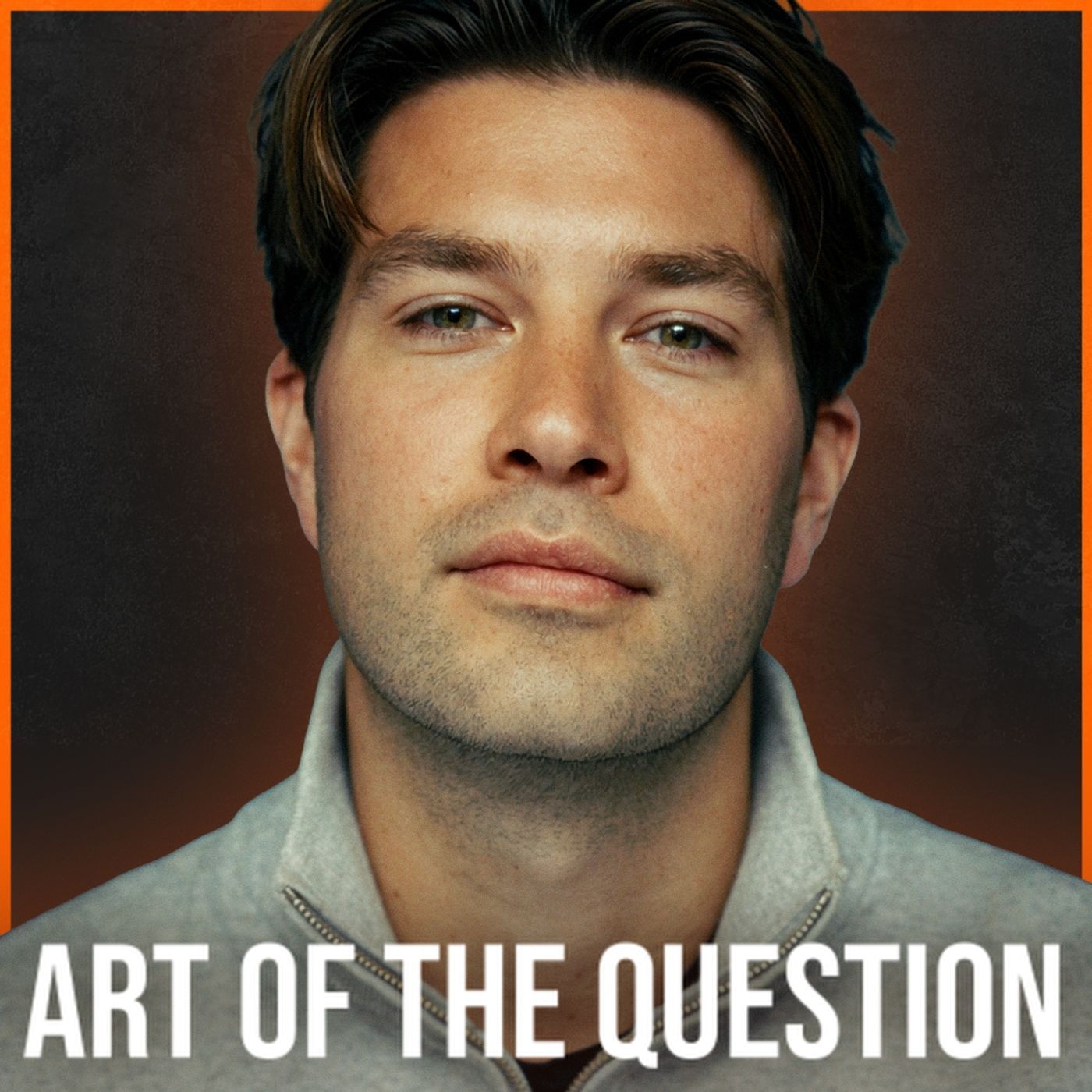
Art of the Question
Andere apps
Pocket Casts Overcast Castro Castbox Podcast Addict AntennaPod RSS-feed
Conversations about science, technology, philosophy, psychology, self-improvement, media, and culture.
Afleveringen
-
Will SpaceX Catch Starship on Flight 15? - Chris Prophet - #71
5 november 2026 · 1 uur 15 min
Chris Prophet is a science fiction and space development writer who covers SpaceX and the emerging space economy on his Substack. He is the author of SpaceX from the Ground Up, a guide to the company now in multiple editions, and SpaceX Evolution, which he has serialized for free on his Substack. His weekly analysis breaks down each Starship test flight in plain, economical language. In this episode he unpacks Flight 14, the first time Starship reached orbit, and what Flight 15 could bring, including an attempt to catch the ship itself with the launch tower's chopsticks. He also explains why SpaceX pivoted from Mars to the Moon and what its planned megabase in Louisiana means for the future of launch. Lees meer
Expect to learn what made Starship Flight 14 so significant, why SpaceX risked expensive Starlink satellites on its first orbital flight, how Starlink is changing air travel, why cryogenic propellant data matters for refueling in orbit, how SpaceX plans to build an orbital petrol station, whether the heat shield tiles can survive repeated flights, how the chopstick catch on Flight 15 could work, how the cost of the booster compares to the ship, why engine failures did not end Flight 14, why Elon Musk pivoted from Mars to the Moon, what the planned Louisiana megabase will look like, and what a permanent settlement beyond Earth could become.
Chris Prophet online:
Substack: chrisprophet.substack.com
Book: SpaceX from the Ground Up, available on Amazon
Book: SpaceX Evolution, free to read on his Substack0:00 Introduction
1:09 Why SpaceX matters
2:56 The new space race
7:25 SpaceX's origins and reusability
8:23 Why Flight 14 was significant
13:00 Starlink payload on Flight 14
19:09 Starlink at 30,000 feet
21:54 What the headlines missed
25:25 Cryogenic fuel explained
28:41 An orbital petrol station
33:47 Dragon and crewed flights
35:28 Heat shield tiles
38:32 Flight 15 and the chopsticks
41:22 Booster versus ship costs
43:37 Engine failures on Flight 14
48:10 The pivot… -
What Happened to the Learjet 60 in Florida? - Dr. Shem Malmquist - #70
3 november 2026 · 49 min
Shem Malmquist is a veteran airline captain, accident investigator and system safety researcher based in Florida, with about 45 years of flying for airlines. He has flown mostly very large aircraft all over the world, including as a Boeing 777 captain, while also working on accident and safety investigations and aircraft certification. He holds a PhD focused on systems safety engineering and system-theoretic methods for understanding accidents, as well as a master's in human factors, and has taught at the Florida Institute of Technology's College of Aeronautics. In this emergency episode, recorded the day after a Learjet 60 crashed in Greenacres, Florida, killing all nine people on board, he explains what is and isn't known so far, from the reported icing and turbulence to the NTSB's early evidence of a breakup before impact. He co-authored the seventh edition of Commercial Aviation Safety, Angle of Attack about Air France 447, and the 2025 book Simulation Training: Processes, Challenges and Solutions. Lees meer
Expect to learn what we know and don't know about the Learjet 60 crash, whether ice is dangerous at cruise altitude, why business jets fly higher than airliners, why air traffic control asks planes to descend, who decides whether it is safe to fly into weather, how air traffic control radar differs from cockpit weather radar, how severe a storm must be to threaten an airplane, whether a dive can rip parts off a plane, why pilots sometimes have to push rather than pull in a dive, whether a Learjet carries a cockpit voice recorder, how charter flights differ from airlines and whether investigators will ever find out what happened.
Shem Malmquist online:
Website: https://malmquistsafety.com
Blog: https://airlinesafety.blog
LinkedIn: Shem Malmquist
Book: Simulation Training: Processes, Challenges and Solutions (CRC Press, 2025)0:00 Introduction
0:49 Shem's career in aviation safety
5:26 First thoughts on the crash
6:50 What we know so far
8:23 Ice at cruise altitude
… -
How Mars Could Split Humanity Into Two Species - Prof. Scott Solomon - #69
2 november 2026 · 1 uur 17 min
Scott Solomon is an evolutionary biologist and teaching professor of biosciences at Rice University in Houston. His first book, Future Humans, made the case that humans are still evolving today. For his new book he spent years following the researchers who study what space does to the human body, from NASA's Space Radiation Lab at Brookhaven to astronaut training in the Neutral Buoyancy Lab. In this episode he explains why a permanent settlement on Mars could set humans on a separate evolutionary path, and how few generations it might take before Martians and Earthlings are no longer the same. His latest book is Becoming Martian: How Living in Space Will Change Our Bodies and Minds, published by MIT Press. Lees meer
Expect to learn how eight months in space weakens muscles and bones, why deep space radiation is more dangerous than what astronauts face on the ISS, what NASA's first bed rest study revealed, whether humans can safely give birth on Mars, why universal C-sections could change the size of the human head, what space experiments on fish and pregnant rats tell us, why species on islands often shrink, how evolution can happen in just a few generations, why Earthlings and Martians may not be able to meet safely, whether Mars settlers will have to go vegan, and why we should answer these questions before anyone is born on another planet.
Scott Solomon online:
Website: solomon.rice.edu
Book: Becoming Martian (MIT Press), available wherever books are sold
Audiobook: Becoming Martian, narrated by Scott, out November 30:00 Introduction
0:57 Why write Becoming Martian
3:28 Are humans still evolving
5:15 The eight month journey
10:43 Muscle loss without gravity
13:34 NASA's first bed rest study
14:36 Radiation experiments on rats
19:41 Shielding a ship with water
24:34 Reproduction in low gravity
26:49 Pregnancy and bone fractures
31:42 C-sections and bigger heads
34:34 Animal studies in space
38:25 Growing up on Mars
40:43 Mars as an island
41:55 Big heads, small bodies
… -
The Ethics of Seeding the Universe - Dr. Asher Soryl - #68
29 oktober 2026 · 1 uur 25 min
Asher Soryl is a philosopher and bioethicist from New Zealand whose work focuses on well-being, suffering and the ethics of wild animal welfare. He studied wild animal welfare during his master's degree and PhD, including a research visit to the Uehiro Centre for Practical Ethics at Oxford. There he met Anders Sandberg, and a three-hour conversation about whether spreading life through space would be a good thing turned into a joint paper. Published in Acta Astronautica in 2025, it weighs the ethics of directed panspermia, the deliberate seeding of other planets with microbial life, and argues for a moratorium until we understand the consequences. Asher is now moving to California to join a biotech startup developing better ways to reduce suffering. Lees meer
Expect to learn what directed panspermia is and where the idea comes from, how cheap rocket launches make seeding other planets feasible, whether someone could secretly seed life in space, why some argue spreading life is a moral duty, how rare life might be in the universe, whether microbes can be conscious, why nature may contain more suffering than joy, how parasites shape the scale of animal suffering, why pain may be stronger than pleasure, whether seeding life could wipe out alien microbes, whether humans should play God with nature, and why Asher and Anders Sandberg call for a moratorium.
Asher Soryl online:
Paper: To seed or not to seed: Estimating the ethical value of directed panspermia, Acta Astronautica (2025), doi.org/10.1016/j.actaastro.2025.03.025
0:00 Intro
0:54 How the paper came about
3:54 What is directed panspermia
6:58 How feasible is it today
11:48 Projects beyond our lifetimes
17:54 Who is working on it
19:18 Seeding life in secret
23:46 The case for spreading life
26:11 Is life rare in the universe
32:43 Can microbes be conscious
36:39 Signs of life on Mars
39:36 How many habitable planets exist
42:00 The welfarist case against
48:33 Suffering in nature
53:49 Parasites and hidde…
-
Is AI Killing Creativity? - Prof. Adam Green - #67
26 oktober 2026 · 1 uur 14 min
Adam Green is a professor and cognitive neuroscientist at Georgetown University in Washington, DC, where he directs a lab studying how the brain produces creative ideas. He earned his PhD in cognitive neuroscience at Dartmouth, did postdoctoral training at Yale, and serves as Editor-in-Chief of Creativity Research Journal. He co-founded the Society for the Neuroscience of Creativity and, with James Kaufman, leads the Creativity Ontology Project, a collaboration of 200 creativity researchers working to pin down what the word creativity actually means. His lab helped turn creativity into something measurable through semantic distance and showed that electrically stimulating the frontopolar cortex can make people more creative. His recent study of hundreds of thousands of college application essays found that after ChatGPT arrived, students' life stories became more alike even as they looked more creative on the surface. Lees meer
Expect to learn how creativity can be defined as a process rather than a product, how semantic distance turns creativity into a number, what happened when researchers zapped the frontopolar cortex with electrical stimulation, why a walk or run in a familiar place helps ideas come, why creativity feels so rewarding, why creativity may be humanity's biggest evolutionary advantage, whether anyone can learn to be more creative, why almost every creativity intervention works, how a strict constraint gave us Green Eggs and Ham, whether AI can truly be creative, how ChatGPT made college essays more alike while fooling the experts, and why thinking for yourself is worth more in the AI era.
Adam Green online:
Lab: cng.georgetown.edu
Society for the Neuroscience of Creativity: tsfnc.org
0:00 Intro
1:07 Defining creativity
8:27 Internally directed attention
10:53 The Creativity Ontology Project
12:20 Measuring creativity with analogies
18:50 The brick test
19:57 Zapping the brain for creativity
23:15 From observation to intervention
25:43 How to be …
-
Why Are People Leaving Big Cities? - Prof. Steven Pedigo - #66
22 oktober 2026 · 1 uur 2 min
Steven Pedigo is an urban economic development expert and professor who has advised more than 100 cities, universities and companies on growth and innovation. Raised in a small town in rural East Texas, he studied at the University of Texas at Austin, Carnegie Mellon and the University of Illinois, and spent about 15 years working alongside urbanist Richard Florida, author of The Rise of the Creative Class. He later became the inaugural director of the Urban Lab at NYU's Schack Institute of Real Estate, founded the LBJ Urban Lab at the University of Texas at Austin, and is a founding partner of the advisory firm CivicSol. In this episode he traces how Austin grew from a sleepy college town into one of America's fastest growing cities, and what that growth cost the people who lived there. He also explains why the predicted death of big cities like New York and Los Angeles was overstated, and why Americans have now largely stopped moving. Lees meer
Expect to learn whether people are really leaving big cities like New York and Los Angeles, why second tier cities like Austin and Nashville boomed, why Americans have stopped moving, how AI is shrinking entry level jobs for graduates, how Richard Florida's creative class theory shaped Austin, what rapid growth costs a city's culture and affordability, why residents are pushing back on data centers, whether a city can grow without losing its identity, why Europe lags behind the US on innovation, whether companies are really leaving California for Texas, what European and American cities can learn from each other, and how climate change could reshape where Americans move.
Steven Pedigo online:
Website: https://iamstevenpedigo.com
CivicSol: https://civicsol.com
X: @iamstevenpedigo
LinkedIn: https://www.linkedin.com/in/iamstevenpedigo
Instagram: @iamstevenpedigo
0:00 Introduction
0:34 How Steven got into urbanism
2:46 Why cities breed acceptance
4:27 Growing up in Amsterdam
7:14 Are people leaving big cities
10:25 Cost of …
-
The Dystopian Rise of Flock Cameras - Prof. Steven Keener - #65
19 oktober 2026 · 1 uur 15 min
Steven Keener is an assistant professor of criminology at Christopher Newport University in Virginia and one of the few researchers who has studied Flock license plate reader cameras in depth. He directs CNU's Center for Crime, Equity, and Justice Research and Policy, which he co-founded in 2021, and serves on the board of Justice Forward Virginia, a nonpartisan criminal justice reform organization. He earned his Ph.D. in Public Policy and Administration from Virginia Commonwealth University, specializing in criminology and criminal justice policy. When a federal judge forced the release of every publicly funded license plate camera location in Hampton Roads, Keener and his colleagues ran the first full geospatial analysis of how these cameras are deployed. They found that race and poverty, not violent crime, best predict where the cameras go. That research is published as "Surveillance Inequality: Race, Poverty and the Geography of Automated License Plate Reader Cameras." Lees meer
Expect to learn what Flock cameras capture beyond your license plate, how pandemic stimulus money helped Flock dominate the market, why the "nothing to hide" argument falls short, how a Dutch court stopped the tax authorities from using highway cameras, whether Flock cameras violate the Fourth Amendment, why state guardrail laws keep failing, how federal agencies get side door access to local camera data, how police officers have used the cameras to stalk people, why the cameras cluster in Black and low income neighborhoods, whether the cameras reduce crime, and how one Virginia town got rid of them.
Steven Keener online:
Email: steven.keener@cnu.edu
CNU profile: https://cnu.edu/faculty/stevenkeener.html
Research: Surveillance Inequality: Race, Poverty and the Geography of Automated License Plate Reader Cameras
0:00 Introduction
0:41 What Flock cameras are
1:53 License plate readers before Flock
4:03 How Flock won over police
5:25 How the cameras work
7:35 What the cameras capture
9:1…
-
Why Do People Cheat on Someone They Love? - Prof. Dylan Selterman - #64
13 oktober 2026 · 1 uur 13 min
Dylan Selterman is a social-personality psychologist and Director of Research and Resource Development at Heterodox Academy, where he also leads the Mike and Sofia Segal Center for Academic Pluralism. Lees meer
He teaches psychology as an adjunct professor at Johns Hopkins University, after four years there as an Associate Teaching Professor and more than ten years as a Senior Lecturer at the University of Maryland. His research covers attraction, relationships and sexuality, moral psychology and dreaming, and he has published in journals including Social Psychological and Personality Science and Archives of Sexual Behavior. His studies on infidelity, including a survey of Ashley Madison users who reported low regret alongside high love for their spouses, challenge the long-held idea that people only cheat when their relationship is failing. He writes the Substack column Sharing A Brain and the Psychology Today column The Resistance Hypothesis.
Expect to learn how researchers define cheating, whether infidelity can happen in an open relationship, what eight motives drive people to cheat, why most cheating has little to do with an unhappy relationship, how those motives predict whether couples break up or stay together, how long affairs typically last, how men and women differ in why they cheat, what a study of Ashley Madison users revealed about love and regret, why we condemn cheaters even when no one is harmed, whether humans are biologically built for monogamy, why being cheated on hurts so much, and why expecting one partner to meet every emotional need can backfire.
Dylan Selterman online:
Website: dylanselterman.com
Substack: sharingabrain.substack.com
Instagram: @seltermosby
X: @SelterMosby
Psychology Today column: The Resistance Hypothesis, psychologytoday.com0:00 Defining cheating
2:38 Cheating in open relationships
3:21 Eight motives for cheating
8:00 Mismatched sex drives
11:17 Alcohol and mixed motives
13:49 What happens after an affair
17:31 Why cheaters hi… -
The Science of Dark Humor - Dr. Sonja Heintz - #63
12 oktober 2026 · 1 uur 6 min
Sonja Heintz is a Lecturer in Psychology at the University of Plymouth, where she studies the psychology of humour and positive psychology. She earned her PhD at the University of Zurich under Willibald Ruch, one of the leading figures in humour research, and has spent around fifteen years studying what makes people laugh and how humour styles differ from person to person. Her work builds a framework of distinct comic styles, expanding the field's long-standing handful of categories into a far more detailed model that now distinguishes twenty-three. One of her studies looked at whether people who enjoy dark humour score higher on so-called dark personality traits, and found everyday sadism to be the strongest predictor. She has also worked with emergency responders, cancer patients, clinic clowns and hospice patients to understand how dark humour helps people cope with adversity. Lees meer
Expect to learn how humour researchers define humour and why the field settled on such a broad definition, what positive psychology is and how humour fits into it, how the comic styles framework maps the different kinds of funny, whether animals have a sense of humour, why humour may have evolved as a mating signal, how dark humour works as a coping mechanism for illness and grief, what Sonja's study found about dark humour and the dark tetrad of personality traits, why sadism predicts dark humour enjoyment more than narcissism does, why a joke is only funny when no one is actually hurt, why men engage in mockery-based humour more than women, how anonymity online changes what people find acceptable to joke about, whether humour can be trained to make you happier, and why some people seem born without a sense of humour at all.
Sonja Heintz online:
Website: plymouth.ac.uk/staff/sonja-heintz
Research: Do Dark Humour Users Have Dark Tendencies, in Behavioral Sciences 2024
0:00 Introduction
3:15 What positive psychology is
5:10 The comic styles framework
12:53 Defining humour and why we…
-
The Controversial History of The Nobel Prize - Prof. Robert Marc Friedman - #62
9 oktober 2026 · 1 uur 57 min
Robert Marc Friedman is a historian of science and playwright, professor emeritus at the University of Oslo, and one of the first scholars to work in the secret Nobel Prize archives. Born in the United States and now a Norwegian citizen, he studied physics, meteorology and theater at New York University, earned his PhD in the history of science at Johns Hopkins, and taught at the University of California, San Diego before moving to Oslo. Lees meer
When the Nobel Foundation opened its files to researchers, he dug into the committee reports, private letters and diaries behind the physics and chemistry prizes, and published his findings in Nature in 1981, which caused a stir in Stockholm. In this episode he explains how a handful of Swedish professors shaped who became a scientific legend, from Einstein's missing prize for relativity to the scandal of Lise Meitner. His book The Politics of Excellence: Behind the Nobel Prize in Science (2001) remains the most detailed study of those archives, and he has turned the same material into stage plays, including Remembering Miss Meitner.
Expect to learn what the official Nobel reports leave out, why one committee member wrote burn the letter at the end of his notes, what Alfred Nobel actually wanted his prize to do, how the early prizes became an Olympics of science and national pride, why astrophysics and meteorology were pushed out of physics, how Allvar Gullstrand tried to block Einstein, how Einstein finally got his prize for the law of the photoelectric effect, why Lise Meitner was denied a prize for nuclear fission, what power and nuclear politics had to do with it, whether the same biases still shape the prize today, and whether the obsession with Nobel Prizes is bad for science.
Robert Marc Friedman online:
Paper: The 100th Anniversary of Einstein's Nobel Prize, Facts and Fiction (Annalen der Physik, 2022), open access at https://duo.uio.no/handle/10852/99569
Book: The Politics of Excellence: Behind the Nobel Prize in Scie…
Vergelijkbare podcasts
-
 De Technoloog | BNR
BNR Nieuwsradio
Laatste aflevering 5 november 2026
-
 De Grote Tech Show | BNR
BNR Nieuwsradio
Laatste aflevering 5 november 2026
-
 Met Nerds om Tafel - een podcast over technologie, wetenschap en popcultuur
Met Nerds om Tafel
Laatste aflevering 4 november 2026
-
 Fontys AI Garage - dé Podcast over AI
Fontys Hogeschool
Laatste aflevering 28 oktober 2026
-
 Understood: The Big Bet
CBC
Laatste aflevering 26 oktober 2026
-
 Machine Gods
NPR
Laatste aflevering 4 november 2026
- Categorieën
- Technologie , Wetenschap
- Status
- Loopt nog
- Verschijnt
- Een paar keer per week
- Lengte
- Meestal 1 uur 15 min
- Afleveringen
- 71
- Laatste aflevering
- 5 november 2026
- Eerste aflevering
- 8 maart 2026
- Taal
- Engels