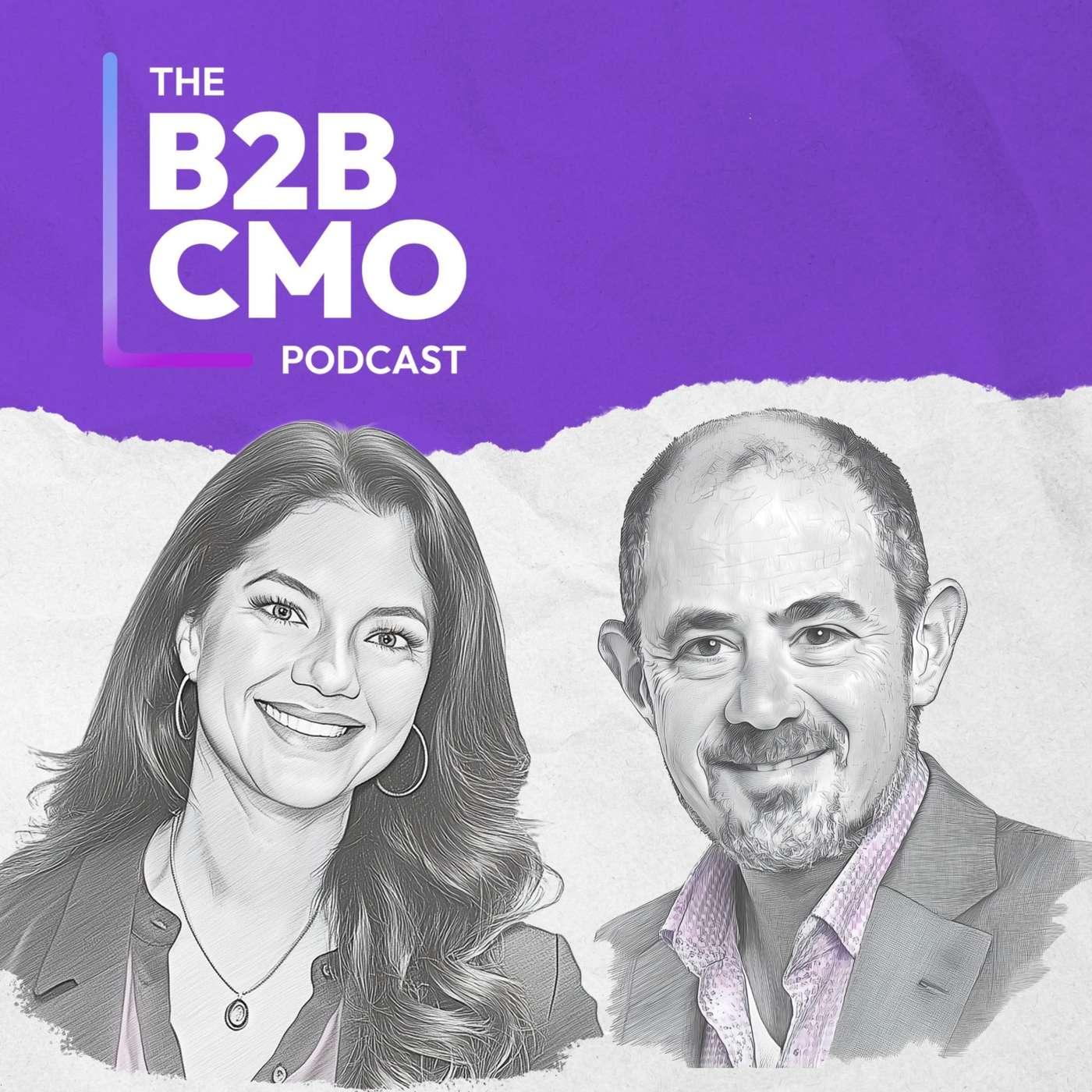
The B2B CMO Podcast with Jon Miller and Sydney Sloan
Andere apps
Pocket Casts Overcast Castro Castbox Podcast Addict AntennaPod RSS-feed
Welcome to The B2B CMO Podcast, a show for marketing executives who are redefining what it means to be a strategic leader. Join Jon Miller and Sydney Sloan every week as they talk with the very best Chief Marketing Officers who are navigating the modern marketing playbook and positioning themselves as strategic leaders.
Each episode, we unpack what it really takes to lead through complexity, earn trust at the strategy table, and shape the future of growth.
We’re building the community, research, and frameworks CMOs need to reclaim their strategic role and drive sustainable growth.
For more marketing leadership resources, visit [b2bcmoproject.com](http://b2bcmoproject.com/).
Afleveringen
-
The Business Hat Every CMO Needs in the Boardroom with Jessica Shapiro, CMO at LiveRamp
2 november 2026 · 35 min
Jessica Shapiro is the Chief Marketing Officer of LiveRamp, where she has led the company into the data collaboration category since joining in 2022. Before LiveRamp, she ran marketing at SAP Concur, held marketing leadership roles at Icertis, launched Starbucks VIA at Starbucks, and spent eight years at Microsoft. Lees meer
In this episode, Jessica joins Sydney Sloan and Jon Miller to share how she earned the right to reposition the LiveRamp brand by fixing the demand waterfall first and cutting cost per opportunity in half. She explains what it takes for a new category to stick, and why she sees governance and agent autonomy as additive instead of in conflict.
Jessica also walks through the offsite where her whole team built their own AI agents, and how LiveRamp now brings one combined brand number to every board meeting.
Jump Into the Conversation
(00:00) Jessica’s path from pre-med to marketing
(03:51) Curiosity and perseverance as marketing superpowers
(05:36) Wearing the business hat as a strategic CMO
(07:29) Why the CRO relationship comes first
(09:11) Earning credibility before repositioning the brand
(13:03) Building the data collaboration category at LiveRamp
(16:56) Setting expectations for category creation with the board
(19:20) Balancing data governance with agent autonomy
(22:49) The ups and downs of LiveRamp’s AI transformation
(27:05) Measuring brand with a composite score
(29:15) What brand metrics to bring into the boardroom
(30:23) Gratitude, mentors, and key takeaways
Episode Takeaways
Earn the brand conversation with pipeline first. When her CEO told her not to start with a repositioning, Jessica rebuilt the demand waterfall, put attribution on everything, and took cost per opportunity from $6,000 to $3,000. That credibility is what got her back to the brand.
Build the category story from what customers actually say. Customer interviews showed people knew the LiveRamp name but each described the company differently, and that gap becam…
-
Building a Movement Instead of Chasing Demand with Katrina Wong, CMO at New Relic
26 oktober 2026 · 32 min
Katrina Wong is the Chief Marketing Officer of New Relic, the intelligent observability platform, where she has led brand, demand, and communications. Before taking on the CMO role, she started her career as a consultant at PwC. She later on became Divisional CMO and VP of Marketing at Twilio Segment and held marketing and go-to-market leadership roles at Hired, Zuora, Salesforce, and SAP. Lees meer
In this episode, Katrina joins Sydney Sloan and Jon Miller to share how New Relic repositioned its category as intelligent observability and turned that into an AI story told chapter by chapter. She explains why she reports new business and post-sale pipeline separately in a consumption business, and why one marketing team owns both.
Katrina also walks through how her marketing engineering and AI team rebuilt reporting on Gemini, the 85 agents running competitive intel every morning, and what happened when an agency sent her team 200 variations to review.
Jump Into the Conversation
(00:00) Katrina’s path from consulting to marketing(05:21) Being a strategic CMO and redefining observability for AI
(09:13) Telling the AI story like chapters of a book
(11:48) How marketing proved AI modernization to the board
(14:18) Separating new business and post-sale pipeline
(16:21) Customer hackathons and the link between engagement and revenue
(18:01) Building a trusted BI layer with vibe coding
(20:53) Humans in the loop and the problem of too much AI content
(23:18) Gemini gems for sales and 85 daily competitive agents
(25:12) The pillars of a superhuman marketing team
(27:05) Gratitude, mentors, and key takeaways
Episode Takeaways
Take a bold stance on your category before someone else sets it for you. New Relic repositioned observability as intelligent observability, was first to claim it, and Gartner recognized the company for its AI vision the following year.
Tell your AI story in chapters. Chapter one explained why AI matters in observability. Chapter two named the pro…
-
Snowflake’s CMO Reinvents Her Playbook Every Year. Here’s How.
19 oktober 2026 · 40 min
Denise Persson is the Chief Marketing Officer of Snowflake, the AI Data Cloud company. With over 10 years in the role, one of the longest CMO tenures in enterprise tech, she has helped take Snowflake from roughly $1 million in revenue to more than $4 billion. She now leads a marketing team of about 700 people responsible for 40 to 50% of the company's growth, and this year marks her 30th in tech marketing. Lees meer
Denise shares why a new CMO's first team is the leadership team, not the marketing org, and why she throws out her own playbook every year. She also walks through how Snowflake's brand team became its most AI-forward function, how her morning brief replaced waiting on dashboards, why Snowflake moved its SDRs back into sales, and why her team is already working next quarter's pipeline two quarters out. Denise shares the one thing she says builds brand trust above all else: consistency.
Jump Into the Conversation
(00:00) Welcoming Denise Persson, CMO of Snowflake
(01:56) From Commodore to 30 years in tech marketing
(05:52) Why the CMO's first team is the leadership team
(10:47) Throwing out the playbook every year
(14:49) Moving marketing from AI fluency to agentic workflows
(19:22) Growing 40 to 50% without adding headcount
(21:35) Replacing dashboards with a daily AI brief
(24:25) Why Snowflake moved SDRs back into sales
(25:59) Fixing a soft quarter two quarters out
(29:53) How AI adoption differs across regions
(32:02) Why consistency builds brand trust
(36:03) Closing gratitude and the leaders who see potential first
Episode Takeaways
Treat the leadership team as your first team. Denise says the day you become CMO, you are a business leader. That means understanding finance, having empathy for the sales craft, partnering with product, and bringing data and customer proof, not opinion, when you push a point of view.
Rebuild your playbook every year and hire for your gaps. Over 10 years at Snowflake, Denise has thrown out her playbook annually. …
-
Leading the Market Through AI Disruption with Demandbase CMO Rachel Truair
12 oktober 2026 · 28 min
Rachel Truair is the Chief Marketing Officer of Demandbase, the pipeline engine for AI go-to-market trusted by some of the world's leading B2B enterprise brands. Rachel joined Demandbase in January 2026 after more than two decades in B2B marketing leadership, including CMO roles at Simpro Group and Cart.com and senior roles at Adobe, Confluent, Oracle, and 3M. Lees meer
In this episode, Rachel chats with Sydney Sloan to look at AI disruption from the customer's side of the table. She shares what Labs by Demandbase is seeing in ChatGPT-referred traffic to B2B websites, why the real opportunity sits with the 95% of buyers who aren't in market yet, and why she may be the first Demandbase CMO to actually run her team on Demandbase. Rachel also makes the case that software should prove its own ROI, and explains how thinking like an investor helps CMOs split their AI bets into separate efficiency and growth stories for the board.
This episode is part of a partnership between The B2B CMO Project and Demandbase, the pipeline engine for AI go-to-market.
Episode Takeaways
Assume your buyers are researching somewhere you can't see. Labs by Demandbase found a roughly 300% increase in ChatGPT-referred traffic to B2B websites over the last year, which means a big share of discovery now happens before a prospect ever lands on your owned properties.
Get the data foundation right before you scale anything with AI. Rachel's version: you avoid running off a cliff by standing on a flat surface. If your data isn't unified and you don't know which signals actually matter, AI just helps you scale the wrong things faster.
Market to the 95%, not just the 5%. When everyone has access to the same in-market data, the advantage goes to the teams that use signals, buying groups, and context to reach buyers before they start an evaluation.
Point AI at the spreadsheets, not the storytelling. Rachel saw AI-generated creative fall flat, and believes the better use is taking reporting, attribution deba…
-
Turning Customer Pain Into Strategic Marketing with Cindy Zhou, CMO at Imprivata
5 oktober 2026 · 38 min
Cindy Zhou is the Chief Marketing Officer of Imprivata, the simple and secure access management platform used by roughly 90% of U.S. hospitals. Before Imprivata, Cindy built her CMO track record at KnowBe4, LogRhythm, and in senior marketing roles at IBM and Verizon, making this her fourth cybersecurity company as a marketing leader. Lees meer
Cindy chats with Jon Miller and Sydney Sloan about her new role to unpack how she built her 30-60-100-day plan, why she believes CMOs need to operate as business executives first, and why she has already told her team to stop talking about MQLs. Cindy also walks through how she prioritizes with her CEO and CRO, why she is tying her customer marketing team's KPIs to retention and churn instead of lead volume, and how KnowBe4's InfoSec team tried to break her first AI SDR before she would let it near a real customer.
Jump Into the Conversation
(00:00) Welcoming Cindy Zhou, CMO of Imprivata
(02:31) How Cindy went from product management to marketing
(07:49) What it means to be a strategic CMO
(10:05) What she brought from past roles into Imprivata's C-suite
(11:36) Seeing the market beyond industry silos
(14:17) How to earn the strategic CMO seat
(19:51) Moving beyond MQLs and tying priorities to strategic metrics
(22:12) Investing in retention and customer marketing
(27:41) How to build brand in an AI-disintermediated world
(29:48) AI SDRs and AI teammates, governance, and human-in-the-loop
(32:01) Closing gratitude, mentors and board members who shaped her career
Episode Takeaways
Treat marketing as a business-executive function, not a departmental one. When Cindy evaluates a new opportunity, she starts with market dynamics and the financials (NRR, GRR, growth rate) before she gets to a marketing plan, because 'chief market officer' only works as a title if you actually understand the market.
Look past the vertical to find the universal pain underneath it. Imprivata's brand is deeply rooted in healthcare, but Cindy makes…
-
Why Your Marketing Org Chart Is Already Obsolete with Dom Colasante, Founder of 2X
25 september 2026 · 21 min
Most CMOs are trying to solve an operating model problem with a job posting. Dom Colasante is the founder of 2X, and he has spent the better part of a decade helping B2B companies run marketing, sales, and customer success as one system. Following 2X's acquisition of KnownWell, he is betting the company on what he calls the human agentic go-to-market model. This model involves expert teams and AI agents fused so tightly you cannot tell which is which. Lees meer
In this rapid-fire conversation, Dom joins Sydney Sloan to explain why asking the same people to own both strategy and execution suboptimizes both, how to sort every piece of go-to-market work into three buckets, and why the single most common mistake he sees right now is a CMO hoping one expensive hire will rewire the whole function.
This episode is part of a partnership between The B2B CMO Project and 2X.
Jump Into the Conversation:
(00:00) Why 2X is betting on human agentic go-to-market
(01:57) Why the go-to-market org chart is finally breaking down
(02:36) What happens when one team owns both strategy and execution
(05:46) Inside the human agentic operating model and the KnownWell acquisition
(07:52) Why every workflow should have both human and AI in it
(09:22) Door one versus door two and why growth beats efficiency
(12:13) The three buckets of go-to-market work
(15:14) Where to start and the honest talent conversation
(17:46) The mistake CMOs are making with the single go-to-market engineer
Key Takeaways
One team owning both strategy and execution suboptimizes both. Strategy shrinks to what that team can personally execute, and execution never gets the full best practice treatment because the same people are busy thinking. Dom's fix is specialization of labor, with the two groups still on one team and the integration point on collaboration rather than day-to-day work.
Once you split them, the marketing, sales, and CS silos stop mattering as much. Execution across all three is largely the same mot…
-
Rebuilding Marketing Automation for the AI Era with Jon Miller, Founder of Marketo and Phave
23 september 2026 · 16 min
Jon Miller is the co-founder of Marketo, where he helped invent the marketing automation category and take the company public. He later co-founded Engagio, which was acquired by Demandbase, where he served as CMO. He's now the founder and CEO of Phave, an AI-native marketing automation platform built to replace the very category he created. Lees meer
In this partner episode, Sydney talks to Jon about what's actually broken in the marketing automation playbook he wrote fifteen years ago. They look at why B2B buying committees now make most of their decision before a seller ever gets involved, what real personalization looks like when it's built on AI context instead of more content, and how his customers are migrating off legacy platforms like Marketo without flipping a switch overnight.
Jump Into the Conversation
(00:00) Why the marketing automation playbook Jon built doesn't work anymore
(02:08) The blind spots baked into legacy marketing automation systems
(04:10) The assumption in "marketing automation" that has to go
(05:04) Real personalization starts with context, not more content
(07:47) Moving from industry-level segmentation to person-level context
(09:05) Why speed became marketing's biggest constraint
(10:18) Replacing the Marketo "high priest" with a CMO who can build campaigns directly
(12:19) How Phave customers migrate off Marketo without flipping a switch overnight
(14:07) Using AI agents to make platform migration painless
Episode Takeaways
Retire the marketing automation model built for a linear funnel. Jon argues the core assumption baked into platforms like Marketo (capture the lead, score it, nurture it, hand it to sales) breaks down against buying committees of 6 to 16 people who've made most of their decision before anyone raises a hand.
Real personalization is about timing and offer, not content polish. Getting the right offer in front of the right person at the right time is roughly 80% of the job. Personalizing the actual content is th…
-
Build Marketing Around Proof, Not Pitches with Lena Waters
17 september 2026 · 43 min
Lena Waters is a marketing executive and advisor who specializes in the inflection point where product-led growth meets enterprise scale. She has built and led global marketing teams across growth, demand, and brand at companies including Grammarly, DocuSign, Responses, and Lookout, and most recently served as CMO at Notion. Across those roles, she's operated both enterprise and product-led growth motions and developed a point of view on how the two can reinforce each other rather than compete. Lees meer
Lena joins Jon Miller and Sydney Sloan to share her controversial take: stop trying to persuade your buyers and start giving them proof instead. In this episode, she breaks down why she'd rather put a marketing dollar into product experience than a brand campaign, and how that thinking took her from DocuSign to Grammarly to running go-to-market at Notion.
Lena walks through how she merged product-led growth with enterprise sales without treating them as competing motions, why she thinks MQLs are measuring the wrong thing, and the three blunt questions every CMO should ask their CEO before taking the job. We also get into why she thinks the AI-native marketing team problem isn't a talent problem at all.
Jump Into the Conversation:
(00:00) Where PLG meets enterprise scale
(01:40) The CMO who resisted becoming a CMO
(03:51) Selling the pony: An origin story in positioning
(07:54) What "strategic" actually means in the AI era
(10:06) Repositioning Notion from note-taking to context platform
(12:44) MQL vs. MQA and letting the data kill the old metric
(15:00) When brand spend is just rented attention
(20:47) Community compounds, awareness evaporates
(23:14) How Notion measured a narrative change
(25:51) Three questions every CMO should ask their CEO
(33:13) The AI-native team is a permissions problem, not a talent problem
(36:24)Why speed beats consensus
Key Takeaways
Replace persuasion with proof. Lena argues that much of traditional B2B marketing has been desig…
-
Inside G2's 2026 Buyer Behavior Report with Alexandra London, CMO of G2
11 september 2026 · 16 min
Alexandra London is the Chief Marketing Officer at G2, the world's largest and most trusted data source in B2B software, serving more than 200 million annual software buyers. She joined G2 to lead marketing into the AI era, building growth engines designed for acceleration, accountability, and long-term value creation. Lees meer
Alexandra joins Sydney Sloan to unpack the findings of G2's 2026 Buyer Behavior Report: The Evaluation Maze: how 82% of buyers have sourced a software recommendation from an AI chatbot, what separates getting cited from winning the answer, and why 49% of buyers had a CFO veto a software purchase that had already been approved.
This episode is part of a partnership between The B2B CMO Project and G2.
Jump Into the Conversation:
(00:00) Meet Alexandra London
(01:28) Why the Buyer Behavior Report matters to CMOs
(03:57) The new research timeline only takes hours instead of weeks
(05:20) How to win the answer, not just get cited
(06:02) Marketing to the human and the agent at the same time
(08:57) The new data point: 49% of CFOs vetoed an approved purchase
(10:27) Why nobody wants to sign a three-year deal anymore
(12:27) Token maxing and bringing the CFO along the journey
Episode Takeaways
The shortlist is now built before you know the buyer exists. 82% of buyers sourced a software recommendation from an AI chatbot in the last 24 months, and review sites and AI chatbots are now the top sources influencing which vendors make that shortlist. Research that used to take weeks to months is now happening in hours.
Getting cited is not the same as winning the answer. Being mentioned is table stakes. What matters is whether your brand is the recommendation the buyer acts on, and whether your own content is what shaped how the model describes you.
Your content has two readers now, and one of them recrawls every 90 days. The models recrawl, re-understand, and repopulate on roughly a 90-day cycle, which means stale content quietly becomes a stale an…
-
Define the Message and the Roadmap Follows with Jamie Domenici, CMO of Klaviyo
31 augustus 2026 · 36 min
Jamie Domenici is the Chief Marketing Officer at Klaviyo, the autonomous B2C CRM. Since joining in 2023, Jamie has guided the company through its IPO and championed Klaviyo's repositioning from ESP to the CRM built specifically for B2C brands, earning recognition as a category leader in Adweek's AI Power 50. She previously served as CMO at GoTo, leading the company's rebrand from LogMeIn, and spent a decade at Salesforce in marketing and customer success leadership. Lees meer
Jamie joins co-hosts Jon Miller and Sydney Sloan to talk about what B2B marketers can learn from B2C's obsession with owning a number and personalizing at scale, how she rebuilt Klaviyo's category story starting from a single bad billboard, and why she's turning content editors into content engineers as AI reshapes her team.
(00:00) Meet Jamie Domenici, CMO of Klaviyo
(02:16) From aspiring politician to marketing ops to CMO
(05:40) Why a CMO's closest partners are sales and product
(08:28) Own a number, and what else B2B can steal from B2C
(11:56) Bringing a point of view to the CEO's keynote
(14:14) The IPO test, can your message fit on a t-shirt
(16:27) The bad billboard that started a category
(18:45) You know a category landed when customers say it back
(19:51) Selling brand to a board that doesn't care about brand
(22:04) AEO becomes its own line item next to SEO
(25:47) Content editors become content engineers
(31:36) Invisible AI and what comes after autonomousEpisode Takeaways
Customer proximity drives strategy. Stay close to customers consistently, not just at major milestones. Ongoing conversations helped Klaviyo understand what customers actually needed, sharpen the narrative around where the company was headed, and make a much bigger strategic call about the category it wanted to own.
Marketing should position where you’re going, not just where you are. Marketing shouldn’t simply describe the company as it exists today, sometimes the job is to define the category you believe the compan…
Vergelijkbare podcasts
-
 De Mediaweek
Audiohuis
Laatste aflevering 2 november 2026
-
 Een Podcastjournaal
Next Episode & Visionair Ordinair & Joep van der Laan
Laatste aflevering 25 september 2026
-
 De Boardroom®
Creativity | Marketing | Digital
Laatste aflevering 3 november 2026
-
 Marketingpraat
Tonny Loorbach & Martijn van Tongeren
Laatste aflevering 4 november 2026
-
 Voorheen Schaamteloos Randstedelijk (VSR)
Dag en Nacht
Laatste aflevering 5 november 2026
-
 Celine Charlotte Podcast
Celine Charlotte
Laatste aflevering 21 oktober 2026
- Categorieën
- Zakelijk , Marketing
- Status
- Loopt nog
- Verschijnt
- Elke week
- Lengte
- Meestal 35 min
- Afleveringen
- 25
- Laatste aflevering
- 2 november 2026
- Eerste aflevering
- 8 april 2026
- Taal
- Engels