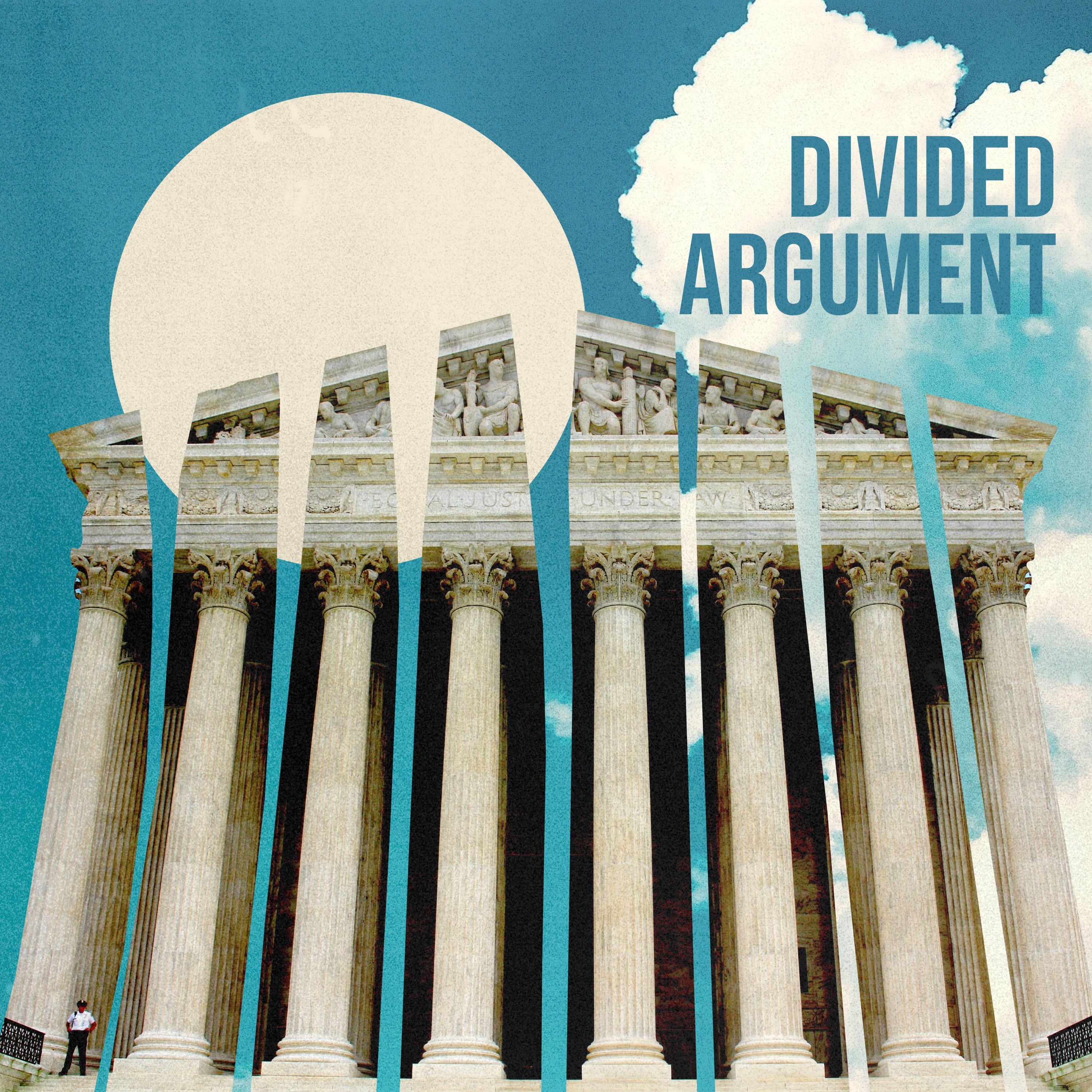
An unscheduled, unpredictable Supreme Court podcast. Hosted by Will Baude and Dan Epps. In partnership with SCOTUSblog.
Afleveringen
-
You Should See the Other Guy
28 oktober 2026 · 1 uur 10 min
Divided Argument — S7E1: Summary & Highlights Lees meer
One-line summary (Beamly)
Season 7 opens with a Court busy not deciding: an Alito recusal, a quorum lost to four book deals, and a stern Purcell per curiam for Missouri.
Show notes
Season 7 opens after a long delay, a dead sound mixer, and a host who punched himself in the face, so we start with the things the Court didn't decide. Justice Alito's late recusal from Suncor Energy v. County Commissioners of Boulder County and the four book deals that cost the Court a quorum in BMG Rights Management v. Vetter get us into the recusal rules and the odd machinery of 28 U.S.C. § 2109. Then the Court's fall run of Purcell rulings: the stay denied in U.S. Postal Service v. California, the unusually stern per curiam in People Not Politicians v. Onder that ended Missouri's redistricting saga, and the stay in Scanlan v. Coalition for Open Democracy. We close with the third trip of Department of Homeland Security v. D.V.D. and its oddly open-ended questions presented. Along the way: Dan's new essay on the justices' books, John Marshall's unread biography of Washington, Rehnquist's unpublished novels, and the other Dan Sullivan.
Highlights
[00:00:22] Opening: the long delay, Will's dead sound mixer, and a water cooler that punched back.
[00:03:05] Why some interim-docket rulings land on the opinions page: the words "per curiam," not the length.
[00:04:53] Suncor v. Boulder County: Justice Alito's recusal a week before the first argument of the Term, his wife's energy stocks, and the awkwardness of spousal conflicts.
[00:09:59] The Chevron v. Plaquemines Parish recusal letter, four days before argument, and the worry that recusal timing tracks whether a vote is needed.
[00:11:49] Suncor itself: a jurisdictional puzzle about the finality of a Colorado Supreme Court remand, and a preemption case with nothing clearly on point.
[00:18:55] Petitioners' best case is Franchise Tax Board v. Hyatt; Will and Steve Sachs's unread amicu…
-
Shoe of Damocles
10 september 2026 · 1 uur 20 min
We're back after a break, and the August interim docket handed us two per curiam standing rulings. In Trump v. California, the Court stayed the injunction against the mail-ballot executive order because the states' injuries were too hypothetical, even as the Postal Service's final rule has already been enjoined and is already back at the Court. In National Park Service v. National Trust for Historic Preservation, the Court let the ballroom construction continue because a historic preservationist's aesthetic injury is "mere offense," which leaves us asking why a crocodile counts and the White House doesn't. We work through ripeness, the Purcell principle turned inside out, the standing realignment that may not have realigned after all, and why the Chief dissented. Along the way: the Justices' papers and who really owns them, a philosopher's note on conditionals, a mixed metaphor unmixed, and the difference between teaching from a script and teaching from a cocktail napkin. Lees meer
Highlights
[00:00:21] Opening: a scheduled Friday recording is no longer unpredictable; Dan is teaching fed courts out of "Baude et al." (Hart & Wechsler), and Will insists he's only holding it in trust.
[00:02:27] Jodi Kantor's NYT story on the justices' papers: Justice Scalia made no plan, Justice Ginsburg's Library of Congress conditions, and whether papers printed on government paper are personal property.
[00:08:17] Will's tentative new institutionalist view: release everything after ten years so the justices have to talk to each other in person.
[00:11:26] Feedback: Yale philosopher Daniel Greco on conditionals in formal logic vs. spoken English; a listener catches Will retelling the "thriving atrocities practice" story from Season 1.
[00:15:27] Two per curiam standing rulings from the August interim docket, 6-3 and 5-4.
[00:16:08] Trump v. California: Executive Order 14399's citizenship lists, prosecution priority, and Postal Service rule, plus a lowercase-r republican form of govern…
-
A Thriving Atrocities Practice
19 augustus 2026 · 1 uur 15 min
After following up on Justice Alito's summer interview, the new birthright-citizenship executive orders, and the Court's record-low approval numbers, we devote the episode to Cisco Systems v. Doe, the Falun Gong surveillance case that closes the door Sosa v. Alvarez-Machain left open for new Alien Tort Statute claims. We try to build a theory of the ATS from first principles — Section 9 of the Judiciary Act of 1789, the law of nations, and the Marbois affair — before running through two decades of the Court narrowing the statute. Then we ask what to make of "door closing" as a phenomenon, from Edwards v. Vannoy to Rucho, and whether the Court would really be stuck if the perfect ATS unicorn finally showed up. Along the way: whether Justice Alito is an I-95 or an Amtrak guy, the seven-case October calendar led by Suncor, Rooker anti-Feldmanism, and a Phoenix bar band called the Blackstone Three. Lees meer
Highlights
[00:00:21] Opening: 29 episodes makes a record-breaking season, and the secret to sub-4-hour recording sessions
[00:02:28] Justice Alito's WSJ interview with James Taranto: "Obviously I'm here for another term," the vultures, and his high school English teacher's psychoanalysis
[00:06:27] How Will became a libertarian: Mr. Flannery, Lexis news alerts for "Ayn Rand," and golfer David Duval
[00:09:48] Still no action on the mail-in voting applications; a White House ballroom emergency application expected any day
[00:11:15] No rehearing petition in Trump v. Barbara — instead, new executive orders probing the decision's edges
[00:15:32] The October calendar: only 7 cases, starting with Suncor — "conservative intuitions in search of a constitutional clause"
[00:17:04] Mailbag: Rooker anti-Feldmanism via Lance v. Dennis, and Michael Rosman on whether sex-segregated sports are really "equal opportunity"
[00:20:32] Gallup has the Court at 33% approval, a record low — the maximally anti-legitimacy strategy
[00:22:35] The main event: Cisco Systems v. Doe — an ano…
-
Very Civilized Orangutans
12 augustus 2026 · 1 uur 9 min
We squeeze in one more episode before Will's vacation, tying the single-season record in the process. The mailbag then demands a reckoning on whether Magneto's powers are really limited to ferrous metals, along with the origins of the S tier and the truth-value of conditional predictions. The main event is Hunter v. United States, which holds that a plea bargain's appeal waiver is unenforceable when enforcing it would work a "miscarriage of justice." We try to figure out where that rule could possibly come from — contract law? Rule 11? the supervisory power? procedural common law? — and why an opinion this law-free commanded this much agreement, while the separate writings range from a declaration of war on plea bargaining itself to a hunt for a sounder source of authority. Along the way: a field trip to the shuttered taproom of Ybarra v. Illinois fame, and thanks to the expanding Divided Argument production universe. Lees meer
Highlights
[00:00:21] Opening: squeezing in one more before Will's vacation — and tying the single-season episode record.
[00:01:42] The only Court news: Trump v. California, the mail-in-voting application, is fully briefed.
[00:03:15] Mailbag: "lead is not magnetic." Are Magneto's powers limited to ferrous metals? The comic-book record says no.
[00:05:40] Why is S the top tier? Japanese video-game rank screens and contested backronyms.
[00:08:09] Parsec retcons in Star Wars, and the art of redeeming past misstatements.
[00:09:09] Caleb Rogers on the logic of conditional predictions: "if A, then B" is true whenever not-A.
[00:11:08] Thank-yous to the production universe — and the show is now on YouTube.
[00:12:06] Jessie Henderson's field trip: the Aurora Tap of Ybarra v. Illinois fame, located and (sadly) shuttered.
[00:15:30] The main event: Hunter v. United States — appeal waivers in federal plea bargains.
[00:21:30] The wrinkle: a forced-medication condition, and a judge who says "you have a right to appeal" anyway (cf. Class v. United …
-
Ice by Magneto
3 augustus 2026 · 1 uur 4 min
We're back — maybe getting a little too scheduled — with one opinion on the docket: West Virginia v. B.P.J. and Little v. Hecox, where the Court held that states may limit girls' and women's sports teams to biological sex without violation Equal Protection or Title IX. First, though, Will collects on a two-year-old prediction when the Court grants Jouppi v. Alaska, an Institute for Justice case about a five-figure airplane forfeited over a six-pack of beer. On the main event, we work through how the opinions are written (no pronouns, no "Lindsay"), what the litigants' Title IX concession did to the case, and whether there is any such thing as an as-applied equal protection challenge. Will makes a big-swing prediction about transgender status and heightened scrutiny, and we ask whether the Court's reasoning can be squared with VMI and the anti-stereotyping cases. Along the way: fencepost problems, Magneto's powers, Magic: The Gathering's crossover-IP wars, scrawny men, and Justice Kavanaugh's ode to the championship trophy. Lees meer
Highlights
[00:00:21] Opening: continuing the roll, "starting to get a little scheduled," and record-setting season ambitions
[00:02:05] Summer interim-docket check-in: a new SG filing on mail-in voting; still no rehearing petition in the birthright-citizenship case
[00:03:23] Filing-day counting and the classic fencepost problem
[00:04:50] Will doesn't condone violence, Dan; UFC, violent video games, and Dungeons & Dragons
[00:07:46] The prediction workflow pays off: Will called the IJ excessive-fines cert push back in May 2024 (Culley)
[00:08:05] Cert granted in Jouppi v. Alaska: a 5-figure aircraft forfeited over a 6-pack of beer
[00:09:58] Scorecard methodology: easy predictions, Magneto clauses, and a slugging-percentage proposal
[00:12:51] Dan's good news: Constitutional Rights in General Private Law, accepted at Harvard Law Review
[00:13:32] The main event: West Virginia v. B.P.J. and Little v. Hecox — states can keep transgender…
-
The Based Direction
27 juli 2026 · 55 min
We're back from vacation and chipping away at the summer backlog. Before the substance: listeners weigh in on our AI-generated cover art, Claude's new prediction scorecard grades our respective forecasting records, and Justices Kagan and Barrett take the Court's budget request — and some docket-terminology talk — to Congress. Then we spend the rest of the show on T.M. v. University of Maryland Medical System Corporation, in which the Rooker-Feldman doctrine, pronounced dead in the Green Bag two decades ago, proves alive enough to reach state-court judgments still on appeal. We try to figure out what the doctrine actually is, whether § 1257 or § 1331 is doing the work, and why the Court's committed formalists split down the middle. Along the way: insider trading as a University of Chicago virtue, a concurrence that may be playing a long game on federal habeas, and a dissent that's "exactly correct and not the law." Lees meer
Highlights
[00:00:21] Opening: back from vacation, episode 26 of the season, chasing the all-time record of 29
[00:01:15] Listener verdict on the AI back-catalog covers — Proximity Mines in the Facility gets its due, and no, we're not commissioning an artist
[00:03:33] Will's Kant remarks draw "especially strenuous criticism"; he declines to recant
[00:04:38] Claude's prediction scorecard grades the back catalog: Dan 82.4%, Will 71.2% — hedged singles vs. high-variance swings
[00:07:06] Are prediction markets just gambling? Kalshi, Manifold, and insider trading as a University of Chicago virtue
[00:10:16] Justices Kagan and Barrett testify before the Appropriations Committees: the security budget, life with a detail, and a remembrance of Lindsey Graham
[00:14:03] Kagan on the "terminology nightmare" — shadow vs. emergency vs. interim docket — and why the shadow docket "is not currently shadowy"
[00:16:14] The main event: T.M. v. University of Maryland Medical System Corporation, a fed-courts-class case if there ever was one
[00:17:44] Doctrine o…
-
Norway-Sweden Worshippers
13 juli 2026 · 1 uur 30 min
We picked two immigration decisions from the same day over the transgender-sports case because — Dan’s protests notwithstanding — that’s where the interesting law is. In Mullin v. Doe the Court lets the administration terminate temporary protected status for Haiti and Syria, holding the statute’s no-judicial-review bar swallows the procedural challenges and that the equal-protection claim fails on the merits — with a genuinely odd move: skipping the jurisdictional question the way Steel Co. says you can’t. In Mullin v. Al Otro Lado a fight about asylum-metering collapses onto a single preposition — whether a migrant stopped at the border “arrives in” the United States — and the majority says no. Along the way: brown M&Ms and Van Halen riders, whether Congress can strip review of constitutional claims without turning in a circle and sprinkling salt on the ground, Bolling v. Sharpe as a candidate for the worst decision ever, and why there’s no White Somalia to run a controlled experiment. Lees meer
Highlights
[00:00:28] Opening: hype music, and listening to your own podcast to get in the mood
[00:01:42] Building a live-show rider with Claude Code, and the Van Halen brown-M&Ms test as a safety checklist
[00:03:18] Blogging origin stories — GeoCities, Movable Type, the death of Google Reader, a ransomed domain
[00:06:26] Why we date-stamp episodes; the “too many episodes” complaint
[00:07:27] Today’s slate: two June 25 immigration decisions, Mullin v. Doe and Mullin v. Al Otro Lado, chosen over the trans-sports case
[00:10:37] A digression on the opinion’s broken line spacing on page 1
[00:12:11] Mullin v. Doe setup: TPS, the consultation-and-review procedures, and the “no judicial review of any determination” bar
[00:19:07] Does the bar reach the procedures or just the bottom line? The Court says the whole thing
[00:24:32] Can Congress strip review of constitutional claims — or must it first “turn in a circle and sprinkle salt on the ground”?
[00:25:01] Dan on his an…
-
Smart Microwave
6 juli 2026 · 1 uur 25 min
After a quick check on the Nina Totenberg embargo kerfuffle and one more revelation from Justice Thomas's memoir, we devote the episode to Chatrie v. United States, the Court's first major Fourth Amendment decision in years. We trace how the geofence-warrant ruling builds on — and goes beyond — Katz, United States v. Jones, and Carpenter v. United States, and what's left of the third-party doctrine and the mosaic theory. Will explains the positive law model of the Fourth Amendment; Dan tries to claim Justice Gorsuch's separate opinion for his general-law approach. We close with the dissents, the advisory-opinion objection, and whether the Court should be saying more about the Fourth Amendment or less about everything. Along the way: Venmo heroin deals, smart microwaves, whether Will has genuinely forgotten his passcode, and a field-trip assignment for Chicagoland listeners. Lees meer
Highlights
[00:00:21] Cold open: three recording sessions in three days, and the theories swirling around the Nina Totenberg screw-up
[00:02:04] Justice Alito's embargo story: the press-room idea he liked until he learned they have to let the journalists out of the room
[00:03:04] My Grandfather's Son follow-up: Justice Thomas's over-cautious marijuana confession
[00:04:35] Cleanup-order watch: GVRs still owed in light of Slaughter, Landor, and B.P.J.
[00:04:57] The main event: Chatrie v. United States, the geofence-warrant case — and why a 5-Justice Fourth Amendment majority is a good get for Justice Kagan
[00:06:51] What a geofence actually is (there is no fence) and the three-step Google Location History protocol
[00:13:52] General warrants, particularity, the University of Chicago backpacks hypo, and Ybarra v. Illinois — with a field-trip assignment to the Aurora Tap House
[00:21:09] Three questions — search, reasonableness, exclusion — and the clever cert grant that fenced out the exclusionary rule
[00:25:52] The setup: Jones and the two tracks of Fourth Amendment doctrine, step 0…
-
Weird Islands
2 juli 2026 · 1 uur 15 min
It's the last opinion day of the term, and the big one landed: Trump v. Barbara, the birthright-citizenship case. We read the majority as the rare easy case and spend most of the episode on why the four dissents each end up somewhere different — and trying to figure out exactly where they actually land. Along the way: a bogus Nina Totenberg story, a Landor GVR that might quietly unsettle a chunk of Spending Clause criminal law, and whether the professors who defended the order deserve the "legal scholarship police." Lees meer
Highlights
[00:00:27] The bogus Nina Totenberg wire story that Justice Alito was retiring — "Fake news, Dan."
[00:02:03] The Justice Alito / Justice Sotomayor bench-dissent dust-up from the immigration hand-downs
[00:03:11] Last opinion day — 3 opinions, 4 cases; NRSC v. FEC and West Virginia v. B.P.J. / Little v. Hecox flagged for later
[00:05:27] A significant new grant teed up on possession of semi-automatic rifles (AR-15s)
[00:06:43] A GVR in light of Landor in a federal arson case, and the narrow-vs-broad theory of what a GVR means
[00:09:34] Whether Landor's narrowing of Sabri could upend a swath of Spending Clause federal criminal law
[00:10:58] Why RLUIPA reaches prisoners — Chuck Colson's post-Watergate lobbying (courtesy of a listener, Emma Kaufman)
[00:12:55] Trump v. Barbara — Trump loses, but closer than predicted: "Trump beats the spread"
[00:15:25] Should professors who defended the order be punished? — "we don't need legal scholarship police"
[00:19:58] The majority's walk: common law → Dred Scott → the 14th Amendment → Wong Kim Ark
[00:26:21] Wong Kim Ark as linchpin, and whether its "domiciled here" language was doing any work
[00:36:48] Justice Kavanaugh concurs in the judgment on the statute, then dispatches the constitutional question breezily
[00:42:05] New states, Hawaii, and Living Originalism — when may you add new exceptions? "Weird islands you can't drive to"
[00:48:33] The 91-page Justice Thomas dissent, the fa…
-
Always Already
1 juli 2026 · 1 uur 13 min
The big opinions are coming fast and furious as the Term ends. This episode, we take on two related cases from the penultimate opinion drop day: Trump v. Slaughter, which overrules Humphrey's Executor and clears away for-cause protection for the independent agencies, alongside its interim-docket companion Trump v. Cook, where the very same logic somehow spares the Federal Reserve. The big question: if the President can fire an FTC commissioner at will, what actually makes the Fed different — is "history" doing the work, or is the Court just saving the bond markets? Along the way: Heidegger's "always already," whether the metaphor of a living tree is consistent with originalism, a Goldilocks definition of "cause," the Chief leaning on his own unworkable precedents, the Ex parte Young mystery that keeps escaping the Court's grasp, and the first appearance of "the interim docket" in the U.S. Reports. Lees meer
Highlights
[00:00:18] The penultimate opinion day — four down, four to go
[00:00:50] The last-day pileup, and the McCain-Feingold campaign-finance case still pending
[00:03:25] A confession: staircase wit, and the metaphor Will wishes he'd used
[00:04:27] The living tree as an originalist — and the petrified-tree rejoinder
[00:06:01] The new custom-cover workflow, and what Claude still isn't allowed to write
[00:07:00] The day's four opinions: Cook, Slaughter, Chatrie, and Watson v. RNC
[00:09:50] Is the Court strategic about opinion timing? A walk back through OT21's last days
[00:13:55] Slaughter before Cook: the general rule before the exception
[00:15:08] "Humphrey's Executor has always already been overruled" — by way of continental philosophy
[00:17:36] Slaughter: the question, Humphrey's Executor, and the road from Morrison v. Olson through Seila Law
[00:22:12] Why presidents mostly haven't tested removal — and whether this shifts the equilibrium
[00:25:29] Walking the opinion: Roberts for the Court, the Thomas non-join, a Sotomayor (not Kagan) dissent…
Vergelijkbare podcasts
-
 You Might Be Right
Baker School of Public Policy and Public Affairs at University of Tennessee
Laatste aflevering 29 oktober 2026
-
 The Law Show
BBC Radio 4
Laatste aflevering 4 november 2026
-
 The Weekly Break Out
Breaking Defense
Laatste aflevering 3 november 2026
-
 The Cato Weekly Podcast
Cato Institute
Laatste aflevering 3 november 2026
-
 RADIO BOOS
NPO Luister / BNNVARA
Laatste aflevering 5 november 2026
-
 Podje DNA
Groep Markuszower / DNA
Laatste aflevering 1 november 2026
- Categorieën
- Nieuws , Politiek , Overheid
- Populariteit
- #3.249 van 40.480 podcasts in Nederland
- Status
- Loopt nog
- Verschijnt
- Elke week
- Lengte
- Meestal 1 uur 10 min
- Afleveringen
- 140
- Laatste aflevering
- 28 oktober 2026
- Eerste aflevering
- 15 mei 2021
- Taal
- Engels