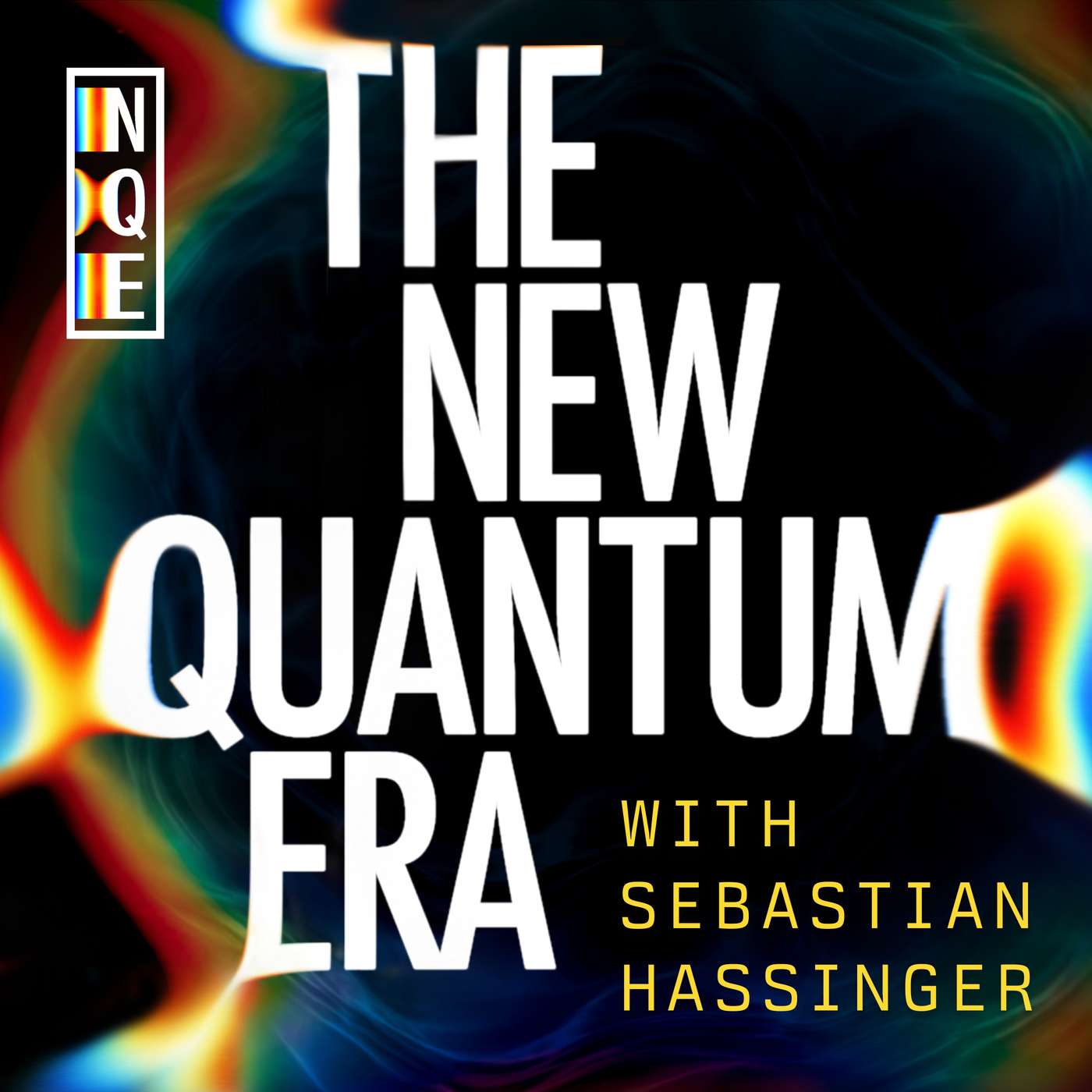
The New Quantum Era - innovation in quantum computing, science and technology
Andere apps
Pocket Casts Overcast Castro Castbox Podcast Addict AntennaPod RSS-feed
Your host, Sebastian Hassinger, interviews brilliant research scientists, software developers, engineers and others actively exploring the possibilities of our new quantum era. We will cover topics in quantum computing, networking and sensing, focusing on hardware, algorithms and general theory. The show aims for accessibility - Sebastian is not a physicist - and we'll try to provide context for the terminology and glimpses at the fascinating history of this new field as it evolves in real time.
Afleveringen
-
Quantum Policy, Topological Qubits, and the Maryland Research Center with Charles Tahan
2 november 2026 · 55 min
Charles Tahan has one of the most unique career arcs in quantum: PhD in silicon quantum computing, postdoc across three continents, fifteen years at the Lab for Physical Sciences running quantum programs and doing original research, then the first Director of the National Quantum Coordination Office at the White House OSTP, and now a Partner at Microsoft Quantum. He is one of the very few people who has both written U.S. quantum policy and is now executing on it from inside a major hardware program. That dual vantage point — policymaker turned builder — gives him a kind of credibility that is rare in a field full of either pure researchers or pure advocates. Lees meer
The timing of this conversation matters too. Microsoft just opened a 15,000-square-foot quantum research center at the University of Maryland's Discovery District, and DARPA has been given on-site access to the Majorana 2 system as part of its Quantum Benchmarking Initiative — the first opportunity for a technically capable independent party to evaluate Microsoft's topological qubit claims. Tahan is candid about the difficulty of what Microsoft is attempting, honest about the timelines, and enthusiastic about the parts of this problem that most people in his position would prefer to keep vague.
Listeners who follow quantum hardware development, national science policy, or the workforce and ecosystem questions around quantum will find this episode unusually grounded.
What We Get Into
How Tahan ended up in government in the first place — starting as a DARPA technical consultant in 2007, helping write the milestones for the first quantum computing programs, and eventually becoming the first Director of the National Quantum Coordination Office
What the NQI actually accomplished — and why Tahan argues its most important effect wasn't the money itself but the signal it sent globally, triggering coordinated national strategies across dozens of countries
Why topological qubits are worth the difficulty — Tahan's h…
-
Atomic-Precision Silicon Qubits and the Path to Fault Tolerance with Michelle Simmons
26 oktober 2026 · 38 min
Michelle Simmons is the founder and CEO of Silicon Quantum Computing (SQC) and a Scientia Professor at UNSW Sydney. She is one of the few people in the field who has simultaneously run a 200-person academic research centre, founded Australia's first vertically integrated quantum computing company, shaped how the community publishes its results (as inaugural editor-in-chief of npj Quantum Information), and influenced national quantum policy. That combination of roles gives her an unusually grounded view of what is actually hard — in the physics, in the manufacturing, and in the business. Lees meer
The conversation is happening at a specific inflection point. SQC published two landmark Nature papers within ten weeks of each other in late 2025 and early 2026 — an 11-qubit silicon processor with two-qubit gate fidelities reaching 99.99%, and a 15,000-site analogue simulator demonstrating a metal-insulator transition. The company has advanced to Stage B of DARPA's Quantum Benchmarking Initiative, a program whose stated opening position is skepticism that fault-tolerant quantum computing is achievable by 2033. And SQC is now shipping an analog quantum AI chip to commercial customers. This episode is for anyone who wants to understand what silicon spin qubits actually are, why the donor-qubit approach is architecturally distinct from the CMOS-foundry approaches most competitors use, and what a credible long-range quantum roadmap looks like when it is grounded in manufacturing reality rather than theoretical aspiration.
What We Get Into
Why qubit quality improves with scale in SQC's system — the physical intuition behind using phosphorus donor atoms as "nature's perfect qubit," and why minimizing interfaces is the key insight that separates this approach from gate-defined quantum dots
The STM as a manufacturing tool, not just a microscope — how Simmons reframed the scanning tunneling microscope as the atomic-scale equivalent of an ASML stepper, and why 25 years of development no…
-
Building a Regional Quantum Ecosystem with Corey Stambaugh
19 oktober 2026 · 30 min
Corey Stambaugh is one of the few people in the quantum world who has worked at the bench, inside federal policy, and now as the operational lead of a major public-private ecosystem initiative. He came up as a precision measurement physicist at NIST, moved to the White House's National Quantum Coordination Office as a senior policy advisor, and now directs the Capital of Quantum — Maryland's statewide effort to translate decades of university research into a commercial quantum industry cluster anchored in the Discovery District at the University of Maryland. Lees meer
This conversation was recorded at the close of the 2026 Quantum World Congress, a week in which Maryland opened the Microsoft Quantum Research Center, announced Riverlane's U.S. headquarters in the Discovery District, welcomed QuEra Computing into the building, and unveiled a new partnership with Paladin Capital Group. If you follow quantum economic development, workforce policy, or the question of which regions are actually building durable quantum infrastructure versus generating press releases, this episode gives you a rare inside view from someone threading all of it together.
What We Get Into
How the Capital of Quantum actually came together — the decades of university research that preceded the January 2025 launch, and what it took to stand up a formal initiative on top of that foundation
What "150,000 square feet and a fridge at 14 millikelvin" means in practice — the Discovery Center build-out, from Microsoft buying the building to pumping down their dilution refrigerator in under a year
Why the tenant list spans almost every major hardware modality — IQM (superconducting), Quantum Motion (silicon CMOS), Microsoft (topological), IonQ (trapped ion), QuEra (neutral atom), and Riverlane (error correction software) are all in or adjacent to the same building, and whether that's strategy or circumstance
The DARPA Capital Quantum Benchmarking Hub — Maryland is one of three states with a memorandum of ag…
-
Quantum Workforce, Sensing, and the Long Game of Operationalization with Isabella Martinez
12 oktober 2026 · 38 min
Isabella Martinez sits at an unusual intersection in the quantum ecosystem: she's not primarily a hardware researcher or an algorithm theorist, but a practitioner who has to make quantum work in operational environments — for customers who have real missions, real constraints, and very little patience for technology that can't be deployed. Her team at Booz Allen spans quantum computing, quantum sensing, and post-quantum cryptography, which means she's watching all three of the field's major near-term vectors simultaneously. Lees meer
This conversation was recorded at Quantum World Congress 2026, and it reflects the mood of that moment: sensing is on the cusp of real deployment, PQC migration is being driven by policy urgency, and quantum computing is still asking the question of when — but the "when" is getting more specific. If you work in quantum and care about how the technology actually crosses the gap from lab to mission, this episode is for you. It's also a genuinely useful listen for anyone thinking about quantum careers, workforce development, or how to build teams that can navigate a technology that doesn't yet have a playbook.
What We Get Into
Why Isabella's biomedical engineering capstone — not a physics class — shaped her entire approach to quantum: The lesson wasn't about building a better device; it was about why a life-saving tool sat unused because no one had time to get trained on it.
The four-stage commercialization arc she uses to frame quantum maturity: Solve for physics, then engineering, then business case, then operationalization — and why that last step is the one the field talks about least.
What quantum sensing deployment actually looks like right now: Including a vivid example of a quantum PNT sensor that "can't get wet" and what happens when you try to put it in a waterproof box without destroying its precision advantage.
Why quantum sensing and quantum computing will diverge in their adoption paths: A drone operator doesn't need to know the…
-
Superconducting Qubits, STAR Architecture, and Diamond-Spin Qubits with Dr. Shintaro Sato
5 oktober 2026 · 41 min
Dr. Shintaro Sato is a Fellow and Head of the Quantum Laboratory at Fujitsu Research, and Deputy Director of the RIKEN RQC-Fujitsu Collaboration Centre. He oversees Fujitsu's entire quantum effort — from device fabrication through error correction architecture, software, and application research — and has been building toward commercial quantum systems since Fujitsu began its serious quantum R&D push around 2020. With over 164 publications spanning graphene nanoelectronics, superconducting qubit design, and fault-tolerant architectures, he brings both deep technical credibility and a rare full-stack perspective. Lees meer
This conversation is timely because two significant developments converged almost simultaneously just before recording: Fujitsu announced a tin-vacancy (SnV) diamond-spin prototype developed with TU Delft and QuTech, and began testing its STAR error-correction architecture on neutral-atom hardware with startup Yaqumo — an explicit signal that Fujitsu is betting on hardware-agnostic software layers even as it races to scale its own superconducting devices. Listeners who follow quantum hardware roadmaps, fault-tolerant computing, or Japan's national quantum strategy will find this episode unusually specific and candid.
What We Get Into
How Fujitsu actually fabricates its superconducting chips — Sato explains how the team adapted Nakamura-sensei's original RIKEN designs, developed their own Josephson junction uniformity techniques, and built a research fab capability from scratch rather than licensing finished devices.
Why packaging is the hardest problem at 1,000+ qubits — not the qubits themselves, but the superconducting wiring, chip-to-chip interconnects, interposers, and the sheer number of control lines running from room temperature to millikelvin. Sato is candid that his engineers "don't want to do it anymore."
What STAR architecture actually does — it's not a new error-correction code; it operates at the logical gate layer above the surface code, …
-
Quantum Venture Investing from the Lab to the Market with Marie Lepske
28 september 2026 · 41 min
Marie Lepske brings a combination that's genuinely rare in venture: a background in applied mathematics and physics, early experience covering quantum at Runa Capital before most generalist funds knew the field existed, and now a GP seat at Constructor Capital, which closed a $110M Fund I in February 2026 with more than half its capital directed toward next-generation computing including quantum. She backed Qnami at Runa — a quantum sensing company acquired by Quantum Design in June 2026, one of the few clean sensing exits the field has produced — and Constructor's portfolio includes QuEra, which raised over $230M in a round led by Google Quantum AI and SoftBank. Lees meer
The conversation matters now because the quantum investment landscape is genuinely changing. SPAC activity, mega-rounds from hyperscalers, and rising valuations are pulling in non-specialist capital at the same time that the science is getting harder to evaluate from the outside. Lepske is one of the people who has to navigate that tension every day, and she's willing to name the failure modes.
Founders building quantum or deep-tech companies, investors trying to understand where specialist and generalist capital intersect, and technically curious listeners who want to understand how the business side of quantum actually works will all find this episode useful.
What We Get Into
Why technical training matters at the earliest stages — and what it actually buys you when a founding team's only asset is a laboratory and an optical table, before there's even a legal entity
How the specialist-versus-generalist divide is evolving — Lepske's 2022 argument that early-stage quantum would stay specialist territory, and how she reads the arrival of Google, SoftBank, and NVIDIA in QuEra's cap table
The due diligence framework for pre-product science startups — team provenance, patent landscape, IP legal review, and how Constructor uses its scientific advisory board to validate founders they can't fully assess inte…
-
Rational Quantum Mechanics and the Qubit Ceiling with Tim Palmer
21 september 2026 · 47 min
Tim Palmer is not a quantum computing skeptic from the outside. He is a Fellow of the Royal Society, a CBE, an IPCC lead author, and the inventor of probabilistic ensemble forecasting — techniques now used in every major weather prediction center on Earth. He did his PhD in general relativity under Roger Penrose. When someone with that profile publishes a peer-reviewed paper in PNAS arguing that the entire fault-tolerant quantum computing roadmap may rest on a mathematical assumption that is subtly and profoundly wrong, it is worth paying close attention. Lees meer
The timing matters. The quantum computing industry is spending billions on the assumption that standard quantum mechanics scales indefinitely — that if you can build enough error-corrected qubits, Shor's algorithm will eventually factor RSA-2048. Palmer's RaQM framework, reviewed by leading quantum foundations researchers including Lucien Hardy and Nicolas Gisin, makes a concrete, falsifiable prediction that this assumption will fail somewhere between 200 and 1,000 error-corrected qubits. That falsification window is opening right now. This episode is for anyone who cares about the foundations of quantum mechanics, the long-term viability of fault-tolerant quantum computing, or the rare pleasure of watching a serious scientist put a real stake in the ground.
What We Get Into
Why Palmer left general relativity and came back to quantum foundations decades later — the conceptual thread connecting chaos theory, climate forecasting, and the geometry of quantum state space
What Rational Quantum Mechanics actually proposes — specifically, why Palmer argues that Hilbert space should be defined over rational numbers rather than the full continuum of complex numbers, and what that means physically
The information-theoretic argument for a qubit ceiling — why, in RaQM, the information content of n entangled qubits grows linearly with n rather than exponentially, and why that creates a hard conflict with the quantum Fouri…
-
Classical Reversible Computing on Quantum Dots with Daniel Loss
14 september 2026 · 49 min
Daniel Loss is RDIA Chair Professor of Quantum Computing and Director of the Quantum Center at King Fahd University of Petroleum and Minerals in Saudi Arabia, where this work was done. He is also one of the most influential theorists in quantum computing. The 1997 Loss-DiVincenzo proposal — that electron spins in quantum dots could serve as qubits — now has more than 9,000 citations and is the conceptual foundation for the semiconductor spin-qubit platforms that Intel, HRL, Diraq, and a wave of European startups are actively building toward. In 2025, Loss was named a Clarivate Citation Laureate in Physics, a designation with a strong historical track record as a Nobel Prize predictor. Lees meer
The reason to listen now is that Loss has turned his attention to a question that predates quantum computing itself: can reversible, energy-efficient classical logic be physically realized? His 2026 paper argues that the spin-qubit hardware the field has spent decades developing is, almost incidentally, the ideal platform to do exactly that — and that the energy advantage over room-temperature CMOS could be so large it would matter enormously for AI inference workloads and data-center power budgets. This episode is for anyone following the spin-qubit roadmap, the energy crisis in classical computing, or the deeper question of what semiconductor quantum hardware is ultimately good for.
What We Get Into
Why reversible computing is having a moment now: The ideas of Landauer, Bennett, Fredkin, and Toffoli have been around since the early 1980s — Loss explains what changed experimentally that makes the proposal feel like engineering rather than philosophy.
The core energy claim, unpacked: Loss walks through why a spin-qubit Toffoli gate operating near 4 Kelvin could cost roughly 10⁵ times less energy than its CMOS equivalent, even after accounting for refrigeration overhead — and where the accounting is still incomplete.
What makes the computation classical and the hardware quantum: T…
-
Quantum-Inspired AI and Tensor Network Compression with Román Orús
7 september 2026 · 41 min
Román Orús is one of the rare physicists who built a foundational mathematical tool — tensor networks — and then watched it become the engine of a unicorn. His 2013 introduction to tensor networks has been cited over 2,000 times; his company, Multiverse Computing, just announced a $570 million Series C at a $1.7 billion pre-money valuation. That arc — from condensed matter theory to Europe's largest quantum software company — is worth understanding on its own terms. But what makes this conversation particularly timely is a May 2026 paper Orús co-authored demonstrating that individual layers of Meta's Llama 3.1 8B language model can be encoded as quantum circuits and executed on IBM's 156-qubit Quantum System Two while the model generates text. It's a proof of concept, not a product — but it's a real result, and Orús is honest about what it does and doesn't prove. Lees meer
This episode is for listeners who want a technically grounded, hype-free account of the quantum-AI intersection: what tensor networks actually are, why they keep getting rediscovered across different fields, where classical simulation of quantum systems genuinely competes with quantum hardware, and what it looks like to build a company at the boundary between those two worlds.
Sponsor Message
The Capital of Quantum is a people story. Built on a top-five quantum PhD program and 35-plus years of quantum research leadership. It's the billion-dollar initiative behind Discovery Center, launching this month with Microsoft, IQM, and Quantum Motion inside. That's why IonQ was born and is headquartered here, and why global companies keep choosing a spot minutes from Washington, D.C. This is where quantum is transforming the world. Come see it at the Quantum World Congress, September 23rd through 25th, College Park, Maryland. CapitalOfQuantum.com.
What We Get Into
What tensor networks actually are — Orús explains the core idea without equations: tensors as the "DNA" of a quantum state, and how a network of them…
-
Quantum Workforce Intelligence from qubitsok.com with Piotr Lewandowski
31 augustus 2026 · 46 min
Piotr Lewandowski is a software engineer based in Poland who, as a side project, has built something that no well-funded research institute has: a continuously updated, ontology-tagged intelligence platform that ingests the entire quant-ph archive, tracks thousands of open quantum roles across hundreds of companies, parses patents and grants and open-source repositories, and links all of it to individual researcher profiles. He is not a tenured academic or a hardware engineer. He is an independent data practitioner, and that outsider position gives him a vantage point on the quantum workforce that insiders rarely have — or rarely share. Lees meer
This conversation matters now because the quantum industry is simultaneously claiming a generational workforce opportunity and struggling to fill highly specialized roles. Lewandowski's data offers a rare ground-truth check on both claims. If you work in quantum hiring, research, policy, or investment — or if you're a student trying to understand what the field actually looks like from the outside — this episode will give you a more honest picture than almost anything else currently available.
What We Get Into
How qubitsok's 500-tag ontology was built from scratch — why Lewandowski chose a tree-structured, parent-child tag system rather than relying on existing academic metadata infrastructure, and how it steers AI toward the most specific and useful classification rather than broad category labels.
What the full quant-ph corpus reveals about researcher mobility — which countries are gaining quantum talent (Germany and China are notable winners) and which are losing it (the US and Australia are among the top brain-drain sources), based on tracking affiliation changes over time in published papers.
The rising share of industry authorship in quantum research — industry-affiliated authors have grown from roughly 3.4% of quant-ph papers in 2005 to nearly 14% in 2026, and what that structural shift might mean for what gets published…
Vergelijkbare podcasts
-
 Zimmerman en Space
Hens Zimmerman
Laatste aflevering 3 november 2026
-
 Borstvoeding voorbij de protocollen - podcast voor zorgprofessionals
Myrte van Lonkhuijsen IBCLC
Laatste aflevering 29 oktober 2026
-
 Scientias Podcast
Scientias
Laatste aflevering 30 oktober 2026
-
 Wetenschap Vandaag | BNR
BNR Nieuwsradio
Laatste aflevering 30 oktober 2026
-
 NRC Onbehaarde Apen
NRC
Laatste aflevering 3 november 2026
-
 Return on AI
BNR Nieuwsradio
Laatste aflevering 2 november 2026
- Categorieën
- Technologie , Wetenschap , Natuurkunde
- Populariteit
- #3.293 van 40.480 podcasts in Nederland
- Status
- Loopt nog
- Verschijnt
- Elke week
- Lengte
- Meestal 40 min
- Afleveringen
- 117
- Laatste aflevering
- 2 november 2026
- Eerste aflevering
- 2 augustus 2022
- Taal
- Engels