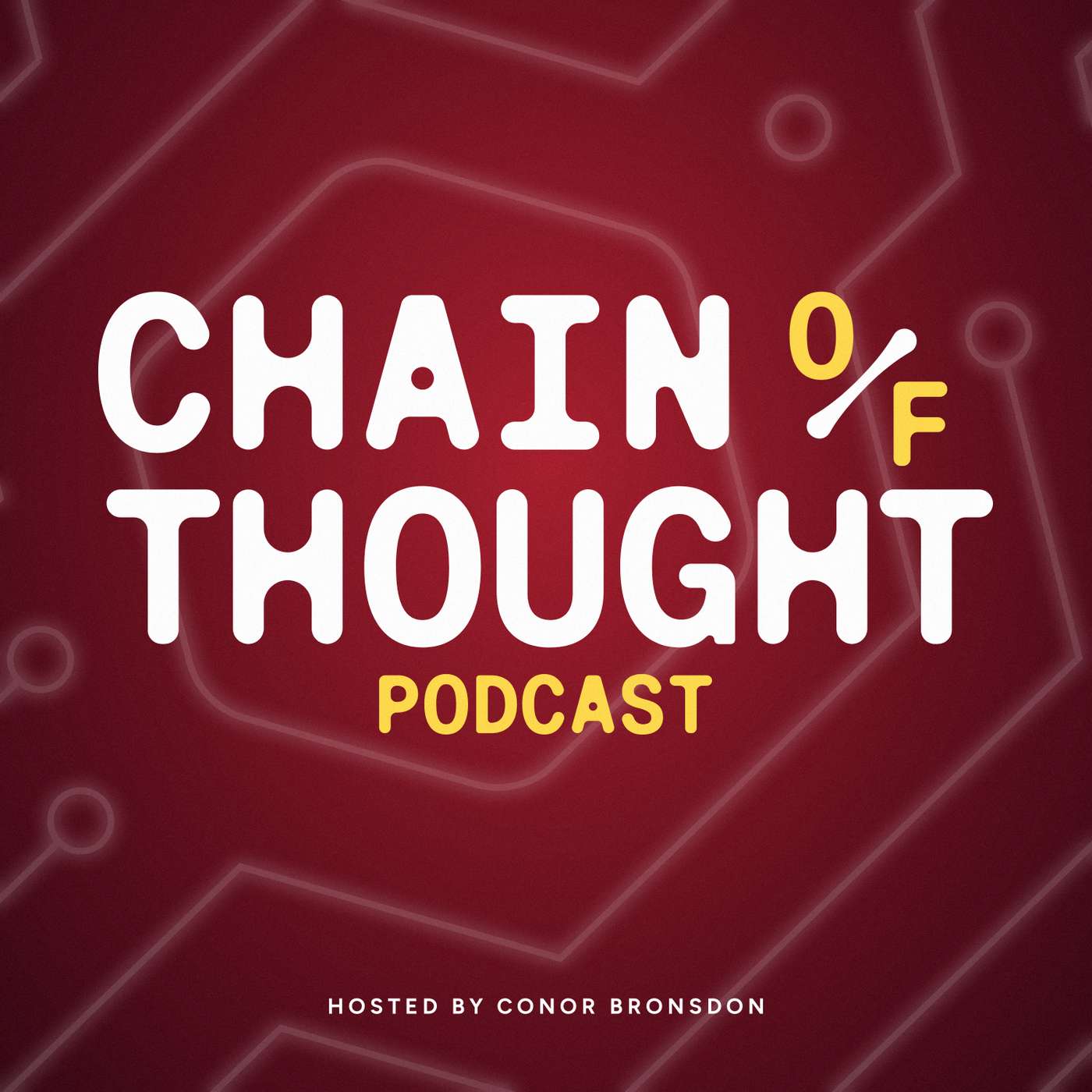
Chain of Thought | AI Agents, Infrastructure & Engineering
Spotify Apple Podcasts Website
Andere apps
Pocket Casts Overcast Castro Castbox Podcast Addict AntennaPod RSS-feed
AI is reshaping infrastructure, strategy, and entire industries. Chain of Thought is the podcast where builders reason through what's changing. Host Conor Bronsdon sits down with the engineers and founders shipping AI in production to get past the hype into what's working and what isn't. Episodes cover model infrastructure, inference, agent frameworks, evaluation, and developer tools.
Guests have come from NVIDIA, Google DeepMind, AMD, Databricks, Vercel, and more. Every episode carries a full transcript and show notes at chainofthought.show. New episodes weekly.
Conor Bronsdon is an independent consultant and angel investor in AI infrastructure and developer tools. He led technical ecosystem at Modular, acquired by Qualcomm in 2026; led developer awareness at Galileo, acquired by Cisco; and ran developer marketing at LinearB, where he was GM of the Dev Interrupted podcast and community.
Views expressed by the host and guests are their own.
Afleveringen
-
Agents Are Overtaking Humans in Search: Why Search Must Be Rebuilt
1 november 2026 · 57 min
Saahil Jain joined You.com as a founding engineer in 2020, when it was a consumer search engine competing with Google. Now its CTO, he builds search for AI agents, and he argues that however smart models get, they will still need tools to find out what is happening in the world. Lees meer
His analogy: we built the self-driving cars before the roads. He walks through which work he expects to move inside the model, why better models made harnesses matter less, and why cheaper open models and routing are giving harnesses a new job. He says he changed his mind on that last point in the past few months.
Then we get into how agents search differently than people do: thousands of queries at once, recall over ranking, and a much wider range of latency needs. Saahil traces a query from fan-out to the index to re-ranking, and explains why You.com judges search by whether the agent answered the question, and why he trusts customer evals and benchmarks that change over time more than static public ones.
We cover:
- Core intelligence versus augmented intelligence, and the self-driving cars that arrived before the roads
- Which tasks Saahil expects models to absorb, and where unverifiable rewards slow them down
- Why frontier labs keep going vertical while open-model labs give weights away
- How stronger models shrank the gap between good and bad harnesses, and how routing across open models can revive them
- How You.com post-trains models with its search tool while trying not to overfit to any one model
- How agent search differs from human search: query volume, context, ranking and latency
- The life of a query: subqueries, lexical and semantic indexes, re-ranking and enrichment
- Why static benchmarks can be memorized, and what dynamic benchmarks and customer evals measure insteadMentioned in this episode:
- I Paid an AI Agent $8 to Write About its ‘Life’: https://newsletter.chainofthought.show/p/i-paid-an-ai-agent-8-to-write-about
- MotionBench: https://motionbench.shConnect w…
-
How Cisco Secures Personal AI Assistants for 90,000 Employees | DJ Sampath
29 oktober 2026 · 44 min
Cisco is giving each of its 90,000 employees a personal AI agent. Some of those same employees are already connecting agents from outside the security boundary without asking IT. DJ Sampath, SVP and GM of AI Software and Platform at Cisco, walks through what had to be in place before the rollout: scanning every prompt, sandboxing each agent, keeping agents multi-tenant, scanning the skills and tools people bring in, and settling which identities an agent may act as. Lees meer
New episodes, the ideas behind them and Conor's essays land in the Chain of Thought newsletter first. Subscribe: https://newsletter.chainofthought.show/
We recorded at Cisco's San Francisco office, a block or two from OpenAI, where Cisco was an early Codex design partner. DJ explains how engineers rework their skills files with each model generation, how per-engineer PR bots review agent-written code, and why defenders now have to move at agent speed when an exploit can show up within minutes of a CVE going public.
We cover:
What Cisco's IT team required before rolling out MyAgent to 90,000+ employees
Prompt injection by email, and why the first integration everyone makes is the riskiest
Cisco's AI security taxonomy, DefenseClaw, and Project Quarry, a new open source language for describing agent behavior and policy
How the agents are actually used: daily briefs, meeting actions, live dashboards, 2 trillion tokens in a single week
Why skills files need refactoring every model generation
Discovering and governing shadow agents with zero trust access
Multi-model code review, spec drift, and evals built from pull request traces
How Cisco Cloud Control was built in about eight months with agentic coding
Chapters:
(0:00) Guardrails tested inside Fortune 100 companies
(0:21) Securing 90,000 employee AI agents
(8:04) Cisco's open source agent security stack
(12:01) Project Quarry: a policy language for agents
(17:07) Personal agent use cases at Cisco
(19:08) Early design partner on Codex
(23:15) Re… -
For AI Agent Fleets, the Model Is Rarely the Bottleneck | Theory Ventures' Andy Triedman
25 oktober 2026 · 49 min
Andy Triedman is a partner at Theory Ventures, and he is building his own software factory, while assessing how startups are leveraging theirs. His read after running agent fleets: the models are frankly good enough for most of the work. The vast majority of things you'd ask an agent to do are not intelligence limited. They are context limited. We have infrastructure work to do - but we can be more ambitious! Lees meer
Full transcript and chapters: https://chainofthought.show/podcast/79-for-ai-agent-fleets-the-model-is-rarely-the-bottleneck-theory-ventures-andy-triedman/
So the hard part moves upstream. Deciding what the agents should build, what they need to know, and when they should stop and ask a person is now most of the job.
We cover:
Moving from solving one problem at a time to building systems that solve whole classes of problems, like generating and testing integrations
Which tasks still need human approval, and which can be fully handed off
Why a short feature spec leaves too much unsaid, and how better questions up front cut review interruptions
Keeping shared context and company decisions current, because an agent takes everything it reads as true
Inference ROI, and when well-scoped tasks can go to cheaper models
Sandboxes and simulated customer environments for agents
First steps for teams: shared skills, cloud agents and approval gates
Protecting customer data, and organizing agent memory from session traces to company priorities
New episodes, the ideas behind them and Conor's essays land in the Chain of Thought newsletter first. Subscribe: https://newsletter.chainofthought.show/
Chapters:
(0:00) Agents are context limited, not intelligence limited
(0:34) From coding agents to software factories
(5:53) What still needs human approval
(10:16) Agent loops that improve the product on their own
(14:52) Where agent automation breaks down
(17:59) The bitter lesson and engineering as experimentation
(20:08) From writing code to directing agent fleets
(24:… -
What Breaks When Agents Become the Customer | Svix CEO Tom Hacohen
15 oktober 2026 · 53 min
What breaks when agents become the customer? Most of the integration layer, APIs, SDKs and webhooks alike, was built for human developers and for servers that are always listening. Agents are neither. Lees meer
Full transcript and chapters: https://chainofthought.show/podcast/78-what-breaks-when-agents-become-the-customer-svix-ceo-tom-hacohen/
When an agent runs on a laptop, closing the lid takes down the tunnel its webhooks come through. When the lid opens, it gets a storm of retries from 12 hours earlier. Svix founder and CEO Tom Hacohen's answer is to let the agent poll for what it missed.
Svix delivers webhooks for companies like Clerk and Resend, and it created Standard Webhooks, the spec OpenAI, Anthropic and Google Gemini have adopted. In this episode of Chain of Thought, Tom joins Conor Bronsdon to talk through designing APIs for agents that adapt, whether agents still need SDKs, and why he wants less code even when agents write it. He also introduces Poke, Svix's new spec for making event-driven APIs work for agents.
This episode is sponsored by Svix.
We cover:
Why events are harder for agents than API calls: the sender controls them, and they arrive outside the agent's session
How polling endpoints and Svix's plugins for Hermes and OpenClaw let an agent pick up where it left off
Why Tom calls JSON an abomination and webhooks duct tape, and why worse is better anyway
Why Svix created Standard Webhooks when everyone implemented webhooks differently, and how the spec let Kong and ngrok add webhook verification
Whether agents still need SDKs, and why Svix's skills work like a solutions engineer while its docs stay written for humans
Why Tom wants less code even when agents write it, and what piling patches on patches costs
Poke, Svix's early spec for letting agents subscribe to and trigger events across services, released so feedback can shape it while it's still malleable
Chapters:
(0:00) Duct tape, retry storms and the case for simplicity
(1:19) Why inte… -
Switching Models Shouldn't Mean Starting Over | Walrus Protocol's Kimberly Logan
7 oktober 2026 · 38 min
If your agent's memory lives inside one model provider, switching models or harnesses means starting over. You need portable memory - yet when switching agent memory between models, you can swing accuracy by thirteen points or more, depending on which model reads them back. Lees meer
Full transcript and chapters: https://chainofthought.show/podcast/77-switching-models-shouldnt-mean-starting-over-walrus-protocols-kimberly-logan/
Kimberly Logan, Head of Product at the Walrus Foundation, where she builds Walrus Memory, joins Chain of Thought to discuss how to build portable and verifiable memory for AI agents - and why Walrus's decentralized storage network has proved an apt primitive. She and host Conor Bronsdon get into why model lock-in is a memory problem, what people use agent memory for beyond coding, how you prove what happened to your data, and why Walrus doesn't publish memory quality benchmarks, plus more. This episode is sponsored by Walrus.
We cover:
Why longer context windows don't help once you switch models or harnesses, and why an import function only fixes one point in time
Why Kimberly doesn't benchmark Walrus Memory against memory startups, and why she sees the opportunity as bigger than memory alone
What people build with Walrus Memory besides coding agents, which Walrus puts at maybe 30% of usage: long-running study aids, trading agents, and security teams comparing production snapshots with code changes
Walrus's figure that almost 85% of the memories written are read back more than 30 days later
How attestations on the blockchain and a delegate key you control let you show what happened to your data, and why unchanged data still isn't proof that it's accurate
Why Kimberly treats recall quality and latency as table stakes, and how a knowledge graph keeps recall on the freshest memories
Why she left almost 20 years in traditional software, including seven at Google, for a blockchain company, and where shared memory across companies and trust bounda…
-
Your Best AI Engineer Might Have the Worst Metrics | Sonar CTO Andrea Malagodi
5 oktober 2026 · 57 min
Andrea Malagodi is CTO at Sonar, which builds AI code verification and governance tools. When finance asked about the size of his team's AI bills, he calculated cost per PR. At one extreme was an engineer with more than 500 PRs in a short period and a low cost per PR. At the other was an engineer with very high spend and very few PRs. Lees meer
Full transcript and chapters: https://chainofthought.show/podcast/76-your-best-ai-engineer-might-have-the-worst-metrics-sonar-cto-andrea-malagodi/
Judged on cost alone, the first engineer wins and the second looks like a problem. Malagodi looked closer. The first had built a personal agent factory, with specification, design review, documentation records, coding, verification and functional testing, and about two-thirds of the output was tests and validations. The second was working on a hard problem that needed the AI to reason through long, multi-turn sessions and didn't reduce to a line count.
Numbers alone tell you something, but not which engineer was doing the more valuable work.
We cover:
Why cost per PR is becoming the industry's standard AI spend metric, and how Malagodi's 500-PR engineer and high-spend engineer broke it
The history of bad proxies, from lines of code to story points to token leaderboards, and why Malagodi says the people who removed code were often the most important
Sonar's guide, verify, solve loop: Vortex for codebase context, algorithmic plus LLM-based PR analysis, a remediation agent for legacy debt, and the Hunter agent for security vulnerabilities
Why Malagodi breaks agent work into small pieces, and why a five-day session that produces 400,000 lines of code leaves you with no idea what is in your codebase
Setting up disagreement between agents with an orchestrator and personas for engineering, product management and quality, plus Conor Bronsdon's cross-model-family review setup
Rolling AI tools out at enterprise scale: one cost view for finance, up to 30% savings from cutting repeated contex…
-
Why Context Alone Isn't Enough for Enterprise AI Agents | WisdomAI CPO Kapil Chhabra
24 september 2026 · 1 uur 23 min
An AI agent answering questions about your business needs to understand how that business works. How do you calculate churn? When does your fiscal year end? Who has the authority to change those definitions? Connecting a model to company data leaves those questions unresolved. Lees meer
Full transcript and chapters: https://chainofthought.show/podcast/75-why-context-alone-isnt-enough-for-enterprise-ai-agents-wisdomai-cpo-kapil-chhabra/
That’s the work of context engineering: giving agents the business definitions, instructions and examples they need to interpret your data. But that context changes as the business evolves, and someone has to keep it accurate.
In this episode of Chain of Thought, WisdomAI co-founder and CPO Kapil Chhabra joins Conor Bronsdon to explain how his team approaches that challenge. We explore how companies maintain shared context, why data teams are taking on the role of AI context engineers, and how a specialized harness plans queries, checks results and repairs errors before returning an answer.
Recorded at WisdomAI’s San Mateo office, this episode is sponsored by WisdomAI.
We cover:
Why the context layer is broader than a semantic layer or catalog, and how it differs from memory
How context drifts, and why a subject-matter expert has to approve changes to shared definitions
Why Kapil sees an AI context engineer role emerging, and why data teams are moving from providing insights to providing context
How WisdomAI's harness decomposes a question, federates queries across data sources and repairs errors, including a customer that replaced a $5M-a-year analytics pipeline
The four ingredients of a trustworthy AI answer: accuracy, consistency, governance and explainability
Live Apps: governed analytics apps built from a single prompt, and what keeps them live
Why your context is your IP and should stay portable
Chapters:
(0:00) Do your agents have the right context?
(1:56) The four ingredients of trust
(5:13) The criticality and impact 2x2
… -
AI Codes: Product Engineers Decide What to Build | Laurie Voss, Arize
22 september 2026 · 56 min
Laurie Voss co-founded npm - now head of developer relations at Arize, he argues that engineers will increasingly earn their keep as 'product engineers': understanding what users need and directing AI agents to build it. Lees meer
Full transcript and chapters: https://chainofthought.show/podcast/74-ai-codes-product-engineers-decide-what-to-build-laurie-voss/
One example: a bakery owner who knows how to make a croissant but has no interest in building software. Someone still has to turn that owner's needs into requirements. Laurie sees that work becoming central to product engineering, with cheaper code making software for narrower industries more viable.
We discuss where he still sees a need for human code review and operational knowledge, what he would look for in a computer science course if he were starting out today (and what he wouldn't do), and why he compares AI today to the web in 1997. He is optimistic about the technology and skeptical of the valuations, while leaving one question unresolved: how do junior engineers learn the judgment this work demands?
We cover:
Why the "aha moment" of solving a problem survives even when agents type the code
Where Laurie still sees a need for human code review, operations, and tacit knowledge
Whether a $15,000 coding bootcamp or a theory-heavy CS degree is still worth it
Why AI in 2026 looks like the web in 1997, and what that says about the bubble
How AI-generated pull requests burden open source maintainers, and why Laurie expects cheaper code to pressure closed-source business models
Why the systems analyst returns as the product engineer, and why that means niche software for bakeries and auto parts
Why Laurie predicts open-model competition and diminishing returns could compress frontier-model margins
How apprenticeships could help junior engineers develop product judgment
Chapters:
(0:00) The shift in software jobs
(0:44) Why Laurie is optimistic about the code generation explosion
(3:06) The aha moment moves … -
Genspark's Bet: AI Agents Become the Users of Software | Wen Sang
17 september 2026 · 1 uur 2 min
Genspark went from launch to $250 million in ARR in about a year. Along the way it shipped a card-thin meeting recorder, open sourced an office suite that Wen Sang says one engineer prototyped in a week, and started running product triage with agents instead of product managers. Lees meer
Full transcript and chapters: https://chainofthought.show/podcast/73-gensparks-bet-ai-agents-become-the-users-of-software/
Wen's bet is that agents, not people, become the next users of software.
Wen Sang is co-founder and COO of Genspark. In this episode he walks through the company's three-layer architecture (models, tools and premium data as the execution layer, a memory layer he calls the second brain, and a collaboration layer called Gen Team), why a meeting note should be the start of work rather than the end of it, the engineering behind the SecondBrain Note, and where he thinks knowledge work goes once agents absorb the busy work.
Disclosure: Genspark provided the SecondBrain Note recorder discussed in this episode at no cost. Genspark is not a sponsor of this episode.
We cover:
Why Genspark builds the self-driving car around the frontier labs' engines, and what that means for people who cannot code
How Genspark's mixture-of-agents architecture routes work across 70+ models, 150+ in-house tools and paid data sets
Evals that grade whether the sales proposal answered the RFP, not whether the model can solve a differential equation
What a meeting turns into a week later when an agent needs it: proposals, pricing models, research, follow-ups
The SecondBrain Note's microphone array, battery decisions, and consent in a two-party state
Why GenOffice went open source, and the one-week prototype story behind it
How Genspark runs product feedback triage with agents and no dedicated PMs
Chapters:
(0:00) Cold open
(0:32) Geniuses with goldfish memories
(3:47) Engines and vehicles: Genspark builds the self-driving car
(6:25) Mixture of agents: models, in-house tools and premium dat… -
Tuning GPU Performance with AI Agents | AMD’s Anush Elangovan on ROCm 10
9 september 2026 · 53 min
Watch the full conversation on YouTube Lees meer
Full transcript and chapters: https://chainofthought.show/podcast/72-tuning-gpu-performance-with-ai-agents-amds-anush-elangovan-on-rocm-10/
AI agents can keep tuning GPU workloads after you step away from the keyboard. Anush Elangovan, Corporate VP of AI Software at AMD, returns to Chain of Thought to explain how that works with Hyperloom and ROCm 10.
Anush and Conor Bronsdon trace the process from installing ROCm through Claude Code or Codex to profiling workloads, finding slow kernels, and testing optimizations while preserving numerical accuracy. Anush shares a Hyperloom run spanning 14,000 models and explains why clear goals and feedback matter when agents are doing the tuning.
They also explore what comes next for engineers: keeping skills and frameworks reliable, managing the security and accountability of autonomous agents, and applying AI to the last mile of useful software.
We cover:
How agents help install ROCm and serve models through natural language
How Hyperloom profiles workloads and uses LLMs to explore optimizations
The role of GEAK in tuning kernels while preserving numerical accuracy
Anush’s account of optimizing 14,000 models in one pass
How software improvements get more performance from existing GPUs
Keeping agent skills current and testing across AI frameworks
Security, accountability, and the next bottlenecks in agent-driven development
Chapters:
(0:25) A decade of ROCm, now agent native
(3:03) What agentic ROCm looks like in practice
(6:17) Installing ROCm then versus now
(9:14) An order of magnitude more CI across every framework
(10:44) Anush’s workflow: agents and deployment
(12:21) Speed is the moat
(15:00) Success is a stranger who cannot spell ROCm serving an LLM
(17:09) Keeping agent skills from going stale
(21:38) Co-designing kernels with the frontier labs
(24:06) Hyperloom, GEAK, and 14,000 models in one pass
(26:45) Managing autonomous agents: control and liability
(32:21) Secu…
Vergelijkbare podcasts
-
 Ons ASML
BNR Nieuwsradio
Laatste aflevering 30 oktober 2026
-
 De Technoloog | BNR
BNR Nieuwsradio
Laatste aflevering 5 november 2026
-
 AIToday Live
Joop Snijder & Niels Naglé
Laatste aflevering 5 november 2026
-
 Understood: The Big Bet
CBC
Laatste aflevering 26 oktober 2026
-
 Machine Gods
NPR
Laatste aflevering 4 november 2026
-
 Met Nerds om Tafel - een podcast over technologie, wetenschap en popcultuur
Met Nerds om Tafel
Laatste aflevering 4 november 2026
- Categorieën
- Zakelijk , Technologie
- Populariteit
- #3.061 van 40.480 podcasts in Nederland
- Status
- Loopt nog
- Verschijnt
- Elke week
- Lengte
- Meestal 55 min
- Afleveringen
- 82
- Laatste aflevering
- 1 november 2026
- Eerste aflevering
- 29 oktober 2024
- Taal
- Engels