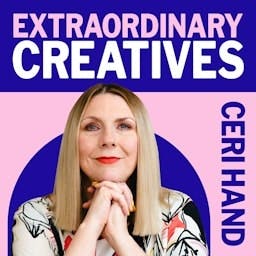
Extraordinary Creatives
Andere apps
Pocket Casts Overcast Castro Castbox Podcast Addict AntennaPod RSS-feed
Extraordinary Creatives: The Premier Art Podcast
Welcome to the Extraordinary Creatives podcast, your gateway to the world of exceptional artists and creative leaders who have defied the odds to make a significant impact in the arts and beyond.
Hosted by Ceri Hand, creative coach, curator, and seasoned arts and business insider, this podcast offers a wealth of insights into art and creativity through in-depth interviews. Ceri’s extensive experience and genuine passion for the arts make every episode a treasure trove of inspiration and practical advice.
At the heart of Extraordinary Creatives is the belief that creativity is essential for success. However, it is the courage, confidence, and resilience to dare to be different that truly transforms the world. With her warm, playful, and straight-talking style, Ceri delves into the ideas, processes, mindsets, victories, and challenges of trailblazers who have paved the way in the arts.
Ceri’s mission is to support 100,000 artists and arts leaders by 2025 by providing exclusive access to information, inspiration, and expertise. Discover the transformative power of art with Extraordinary Creatives. Tune in and follow so you don’t miss an episode!
Afleveringen
-
How to Talk About Personal or Vulnerable Work
5 november 2026 · 22 min
If you're making work that comes from somewhere deeply personal, how much do you actually have to tell people about where it came from? Lees meer
I've been thinking about this because it's something that comes up quite often when I'm working with artists. Perhaps you've been through a bereavement, an illness, a relationship ending, a difficult childhood, or something else that has affected you profoundly. Inevitably, that experience has found its way into the studio.
Then you get to the point where the work has to leave the studio.
You need to write about it. Somebody asks you about it in a studio visit. You're writing your About page or preparing for an artist talk and suddenly there's this question: how much do I say?I think that's a really interesting question because there's a difference between something being important to the work and thinking you have to explain it publicly.
Some artists are extraordinarily open about their lives.
For those artists, that degree of revelation became part of their language. You may want to do that too, or you may want to say a lot less about your experiences. This episode will help you to get the balance right, for you.KEY TAKEAWAYS
Think about boundaries and what you want to share before you publish. Once something is part of your public story, people will ask about it. What feels right to share mid-processing may not feel right in five or ten years.
Give people enough context to open the door, then stop. Think less about how brave you ought to be. Think more about what information genuinely helps somebody meet the work.
Sometimes explaining everything can actually make the work smaller. The story can also follow you for years.
BEST MOMENTS
"The person looking at the work doesn't necessarily need the details of what happened, who it happened to, when it happened or what you went through. You get to decide where that boundary sits."
"We sometimes confuse honesty with disclosure.
“Making vulnerable work doesn't mean you hav…
-
Sustain the Thing That Sustains You: Finding Your People, Backing Your Work and Building an Art Career with Robin F. Williams
2 november 2026 · 1 uur 15 min
What happens when you expect your art to become your entire “existential dread receptacle”? Lees meer
That brilliant phrase comes from my guest today, Robin F. Williams, and it opens up a conversation I think a lot of artists need to hear about how you protect the creative practice that gives your life meaning without asking it to do absolutely everything for you.
Robin is a Brooklyn-based painter whose extraordinary work moves between art history, horror, gender, technology, and our strange relationship with AI. Their work is held in The Brooklyn Museum, ICA Miami and at the Colombus Museum of Art.
We spoke just before Act Natural, Robin´s first UK solo exhibition, opened at No.9 Cork Street in London, where the new paintings move from Siri and language models to mermaids, Terminator 2, and Renaissance painting. and the increasingly slippery question of what we even mean by “natural.”
We also get underneath their career: getting stuck, the group of women artists who helped Robin keep going, what nearly twenty years with P·P·O·W has taught them about gallery relationships, and why success comes down to sustaining the thing that sustains you.
KEY TAKEAWAYS
Don't ask your art to carry everything. Painting can't be your only outlet for anxiety, so build other practices around it: sleep, exercise, writing, even playing a guitar badly. These release valves keep your main practice vital and light.
Let ideas tell you their size. Make studies, like Robin's gouaches, and live with them. If an idea keeps asking questions, it may deserve a big painting; if not, it's finished at that scale. Bigger isn't always more meaningful.
Find your people. A trusted crit group offers honest feedback, moral support, and permission to follow your instinct. Don't wait for an invitation: gather a few friends and one willing organiser and start your own.
Believe in your work first. A gallery can give you runway, but it can't supply your confidence. Learn the business side, but don't let it cons…
-
How Your Creative Obsessions Can Help You Find Your People
29 oktober 2026 · 17 min
I want you to think about somebody whose opinion of your work really matters to you. Lees meer
Perhaps it's a curator you've admired for years, an artist whose practice you find fascinating, a gallery director you'd love to work with or somebody who has introduced you to extraordinary art.
Now imagine you have the opportunity to spend an hour with them.
What would you actually want to talk about?
I ask because I think artists can spend an enormous amount of time pursuing opportunities without always considering whether they're connecting with the right people.
And having spent much of my working life selecting exhibitions, working with artists, and making decisions about which projects to support, I know how much our individual interests shape those decisions.
Over the last couple of weeks, I've been exploring how we develop our own artistic point of view: first looking at when research becomes art, and last week inviting you to choose ten artworks that make you feel glad to be alive and consider what those encounters might reveal about the kind of work you want to make.
Today, I want to explore how that understanding can help you find people who genuinely connect with your work, and how you might build relationships that are creatively rewarding for both of you.
KEY TAKEAWAYS
Spend a little time thinking about the person who's going to be looking at your application. What are they interested in? What kinds of questions seem to preoccupy them? And what makes you think your work might lead to an interesting conversation with them?
Instead of trying to perform or network awkwardly at exhibition openings, start with the work by visiting things you are genuinely curious about and asking questions you actually want answered.
Build a constellation of people around your practice, over time. People who understand different aspects of your work, challenge you, and share your genuine curiosity.
BEST MOMENTS
“Selectors aren't neutral. We bring our histories, interests, exp…
-
Who Gets Remembered in Art and Why? with Alona Pardo, Director of The Arts Council Collection
26 oktober 2026 · 1 uur 24 min
Some of the decisions that shape art history never make it into the official record. They happen in conversations, through relationships, and because somebody is prepared to champion an artist before the market or the wider art world has decided they matter. Lees meer
My guest today is Alona Pardo, Director of the Arts Council Collection and a Turner Prize jury member. Before taking responsibility for this extraordinary national collection of more than 8,500 works, she spent thirteen years at the Barbican, curating major exhibitions including Masculinities, RE/SISTERS, and Dorothea Lange’s The Politics of Seeing.
We talk about how artworks actually enter public collections, why archives can be unreliable witnesses, what happens to a work after it’s acquired, and Alona’s ambitious plans to bring the Arts Council Collection together in Coventry.
At the end Alona also reveals the secret hope she has for what she might achieve during her tenure. I for one would like to see it happen.
KEY TAKEAWAYS
Public collections are living archives. They bring historical works back into cultural discourse through the lens of today, helping us think and feel our way through the complexities of our time.
Official archives can be unreliable witnesses. They depend on what was deemed important enough to record at the time, so part of the narrative always gets left out.
Informal conversations, negotiations, and backstage advocacy are all critical to shaping art history.True curatorial practice avoids a singular authorial voice, actively inviting challenge and collaboration from artists, writers, and scholars to expand and deepen how stories are told.
Encountering structuralists and French feminism at university empowered and galvanised Alona. It shaped a lot of what she studied, her purpose and the direction of her career.BEST MOMENTS
“The best works that I've ever encountered are works that kind of hit you in the stomach and really, really live with you and stay with you.”
“What I was…
-
What I'm Looking For When I Select Art For Open Calls And Prizes
22 oktober 2026 · 18 min
When I’m selecting for an open call or art prize, I might be looking at hundreds, sometimes thousands, of artworks. So, what actually makes me stop at one and think, hang on, I want to see this in real life? Lees meer
I wanted to share what’s actually going through my mind when I’m choosing from all those images to help you look at your own applications differently. Instead of wondering what everyone else wants to see, I want to help you figure out how to stop second-guessing yourself, drop the anxiety of playing it safe, and give your bravest, most distinctive work the best possible chance of catching a selector's eye.
KEY TAKEAWAYS
If you've made something that gives you that little whoosh of excitement, something you are slightly nervous about showing, perhaps that's the work you should be considering.
You don't have to play it safe by submitting something that's simply nice; selectors would much rather encounter an artwork that makes them think, blimey, what's going on here?
You don't have to second-guess everything a selector might like. But looking at who is selecting and what the institution is trying to achieve gives you a much more informed way to choose what to submit.
Invest in the quality of your documentation, because your photographs need to give the work the best possible opportunity to communicate its particular qualities, especially when you're not there to advocate for it.
BEST MOMENTS
“What matters is what meaning I can glean and whether the artist has created an encounter that stays with me.”
“Sometimes I'll select a work that's technically less accomplished than another because there's something odd happening within it.”
“Generally, I'm looking for something that makes me curious, something that catches me off guard or makes me want to spend more time with it.”
PODCAST HOST BIO
With over 35 years in the art world, Ceri has worked closely with leading artists and arts professionals, managed public and private galleries and charities, and curat…
-
The Weight of Imagination: Art, Memory, and Making with Andy Holden
19 oktober 2026 · 1 uur 43 min
What would it be like to meet every version of the artist you’ve been over the last twenty years? Lees meer
That’s essentially what Andy Holden has just done.
For his new book, Weight of Imagination, Andy re-performed works from across his career, encountering his younger selves along the way. The teenager who wrote an art manifesto with his friends.
The young artist returning a piece of stone he’d stolen from the Great Pyramid of Giza. The artist who had to become a cartoon to understand the laws of a cartoon universe. And the musician who found that playing with his band, The Grubby Mitts, could keep his creativity alive when making visual art became difficult.
In this conversation, we talk about what happens when you refuse to abandon the ideas that once mattered to you, how to keep making through periods of doubt, and what twenty years of work can teach you about the artist you’re becoming.
I’m Ceri Hand. I’m an artist coach, and on Extraordinary Creatives I get inside the lives of remarkable creative people to discover how they make their work and build a life that allows them to keep making it.
I can’t wait for you to get to know Andy Holden.KEY TAKEAWAYS
Looking back can be more than a way of taking stock; it can bring earlier versions of ourselves into conversation with the present.
Revisiting old work may reveal not a single, tidy through-line, but seeds and questions that are still alive and have potential.
Let the story help you find its medium. Sometimes the work asks you to learn a new skill or make something imperfectly, because the way it is made needs to carry the same meaning as what it says.
Creative practice can ask us to hold opposing truths at once: irony and sincerity, hope and pessimism, confidence and doubt.
Art need not resolve those tensions; it can help us stay with their complexity and carry that capacity into life.
BEST MOMENTS
“If It is curious to you, it will be curious to somebody else.”
“Don't try and reflect and analyse. Or cr…
-
What Kind of Art Makes You Glad to Be Alive?
15 oktober 2026 · 16 min
What kind of art makes you glad to be alive? Lees meer
I don't necessarily mean the work you think is important, the artists you're supposed to admire or the exhibitions everybody's talking about. I'm interested in the work that gets under your skin. The things you find yourself thinking about years after you've encountered them. The things that make you feel more curious about being in the world.
And I wonder how often, as artists, we give ourselves permission to think about that.
Last week, I was talking about the moment when research becomes art. I was asking what happens when all the information you've gathered, the things you've discovered and the ideas you've explored undergo some kind of transformation through your particular way of seeing.
This week, I want to explore where that way of seeing might come from.
KEY TAKEAWAYS
Your enthusiasm can tell you things that your intellectual understanding hasn't quite caught up with. When a piece of art or something else prompts a strong reaction in you, take note of why it interests you, what makes you laugh, ask questions, relaxes you or even what makes you feel uncomfortable.
If you're continually editing your interests according to what you think other people will approve of, you can lose touch with the things that made you excited about making art in the first place.
Seeing someone else's work and feeling a little pang of envy can be revealing, not because of their success, but because they've made something you wish you'd had the courage to make.
Gather ten artworks that make you feel glad to be alive and identify the recurring qualities. Use those insights to see if there are qualities you admire in others' work that you haven't given yourself permission to explore in your own studio.
BEST MOMENTS
"When I ask them what they find exciting about somebody's work, sometimes they struggle."
"If you discover a contradiction between what you love and what you're making, don't immediately assume you need to change ev…
-
What Art Can Do About Climate Change? - with Alice Sharp and Rana Begum
12 oktober 2026 · 1 uur 29 min
What can art do about climate change that science, facts, and frightening headlines can’t? Lees meer
That question has driven curator Alice Sharp for more than fifteen years. As Artistic Director of Invisible Dust, she brings leading artists and scientists together to create something neither could have arrived at alone.
Her latest project, Climate Clock, created for Oulu’s year as European Capital of Culture in Finland, brings together seven permanent public artworks exploring climate change through our relationship with nature and time. Each artist was paired with a scientist, with Alice creating the conditions for those conversations to become something genuinely new.
One of those artists is Rana Begum, whose collaboration with glaciologist Alan Hubbard transformed footage of glaciers breaking apart into a monumental work made from locally sourced stone, evoking both the weight and fragility of ice.
In this conversation, Alice talks about trust, risk, fundraising, scientists, communities and the invisible infrastructure behind ambitious public art. Rana takes us inside the artist’s process: what happens when new knowledge enters your imagination, how work changes as it meets a place, and why the best collaborations leave room for surprise.
And we ask: if information alone isn’t changing our behaviour, can artists help us feel our way towards a different future?
KEY TAKEAWAYS
Art can help us imagine climate futures in ways that facts and science alone cannot. Bringing artists and scientists together creates space for new perspectives, questions, thought provoking work and unexpected outcomes.
Art doesn’t have to turn climate science into a neat lesson. It can hold beauty and fear together, creating a pause where people can feel, notice and ask questions.
Public art doesn’t need to be removed from everyday life to have impact — placing challenging work where people encounter it unexpectedly can start conversations and change how communities see themselves.
Artists…
-
When Research Hasn't Become Art Yet
8 oktober 2026 · 17 min
At a recent exhibition opening, I was talking with an artist whose work I admire. We were looking at work that was beautifully made and meticulously researched, yet somehow, I wasn’t moved. Lees meer
The artist described it as research that hadn't become art yet.
I thought that was such an interesting observation, because it describes something I've encountered many times over the years
A fascinating subject, impeccable research and extraordinary skill don’t always add up to an artwork that feels fully alive. Over the next three episodes, I’m exploring how you develop your own artistic point of view: how research becomes art; what the works that make you feel glad to be alive can teach you about what you want to make; and how that understanding can help you find people who connect with and champion your work.
It’s easy to get caught up in producing, explaining, and promoting work without asking what you want it to do. So today, let’s start with research: when does it stop being information you’ve gathered and become something only you could make?
KEY TAKEAWAYS
Sometimes a work can feel like a presentation of research rather than artwork. Often, because the artist hasn’t yet made the personal choices that transform it into work that moves them and others.
Don’t let research postpone creating. There will always be another book to read or person to interview. Sometimes the next discovery comes from trying something, getting it wrong, and seeing where the experiment takes you.
The transformation doesn't have to be dramatic, but there's a difference between representing something you found and making a decision about it that opens up a new experience for somebody else.
Give the viewer a chance to meet the work before they meet the backstory. Notice what they’re curious about, where they linger, and what surprises them. Their response can show you what’s already alive in the work and where to take it next.
BEST MOMENTS
“Sometimes, when an artist tells me about a new pro…
-
Learning How to Really Look, Understand And Uncover The Story with Daniel Crouch
5 oktober 2026 · 1 uur 30 min
How does a sixteen-year-old looking for beer money become one of the world’s leading dealers in rare maps, selling extraordinary objects for millions and occasionally outbidding the Library of Congress? Lees meer
Today I’m talking to Daniel Crouch, founder of Daniel Crouch Rare Books, because I’ve always been fascinated by maps. They might look like records of the world, but they’re also records of how somebody wanted us to see it: who owns what, where borders lie, what gets included and what disappears.
Daniel has spent his entire working life learning how to look. We talk about a magnificent sixteenth-century world map that may have been made for political negotiations between kings; a 5,000-year-old clay map bearing its maker’s thumbprint; and the nineteenth-century map he bought for £100 at a car boot sale, only to discover his own house sitting right in the middle of it.
But beneath these extraordinary objects is a much bigger conversation about curiosity, storytelling, value, collecting and what happens when you spend a lifetime paying very close attention.
I loved this one. I think you will too.
KEY TAKEAWAYS
Work that feels topical, disposable or culturally specific today can become an important historical record tomorrow. The fact that something was made quickly or for a short-lived audience doesn't make it artistically or historically insignificant.
Go and look again at something you think you already know. Stay with it a little longer. Ask who made it, why they made it and what you can see that somebody else might miss - sometimes the extraordinary thing isn’t hidden at all. We just haven’t learned how to look yet.
Looking is never neutral. Somebody has made a choice about what to include, what to leave out, where to place the centre, where to draw a boundary. Every creative work is also a way of deciding what the world looks like.
Expertise doesn't arrive all at once. Daniel built his eye slowly by looking, touching, researching, talking, making mistakes…
Vergelijkbare podcasts
-
 Parel Radio
NPO Luister / VPRO
Laatste aflevering 23 oktober 2026
-
 Verhaal van je Leven
De Telegraaf
Laatste aflevering 3 november 2026
-
 De Geknipte Gast
NPO Luister / BNNVARA
Laatste aflevering 31 oktober 2026
-
 Daphne's Hulptroepen
Dag en Nacht | Podimo
Laatste aflevering 3 november 2026
-
 Opium
NPO Luister / AVROTROS
Laatste aflevering 4 november 2026
-
 Echt Gebeurd
Laatste aflevering 5 november 2026
- Categorieën
- Vrije tijd , Maatschappij , Cultuur , Kunst , Persoonlijk , Dagboeken
- Populariteit
- #3.850 van 40.480 podcasts in Nederland
- Status
- Loopt nog
- Verschijnt
- Een paar keer per week
- Lengte
- Meestal 45 min
- Afleveringen
- 258
- Laatste aflevering
- 5 november 2026
- Eerste aflevering
- 2 oktober 2023
- Taal
- Engels